


 3 min read
 10.16.2025


 02.23.2026
 10 min read
Andrew Shepard is a roulette specialist with more than ten years of field experience. He covers international markets across Europe, Asia-Pacific, and the Americas. At Daybet.biz, he leads content on strategy testing, simulators, and game mechanics.

It is no secret that both men and women around the world participate in gambling activities of different forms, but can the participants' level of risk-taking be influenced by their gender? We became fascinated by this question and have conducted thorough research to answer it to the best of our ability. The findings, based on extensive research from academic journals, government studies, and peer-reviewed publications, reveal complex patterns that challenge common assumptions about which gender is "riskier" in the context of gambling.
One of the biggest paradoxes that we’ve come across is the fact that even though men statistically gamble more, women show faster progression to problem gambling. But why “problem gambling,” you might ask? That is because “problematic gambling” is the closest one can get to “riskiness” in the science realm. People with gambling-associated disorders tend to be more prone to risk-taking, boosted by their need for constant excitement seeking. The individuals mentioned will be the subjects in most of the studies cited in this article.
According to this study, 69% of men vs 36% of women gamble regularly. Out of those mentioned, 20.1% of male gamblers vs only 7.8% of female gamblers are reported to have gambling problems. That gender gap is narrowing significantly, though, with women progressing from recreational to problem gambling in ~8 years vs ~12 years for men. What’s also worth mentioning is that research shows women start gambling later (average age 31.3 vs 22.4 for men) despite developing problems faster.
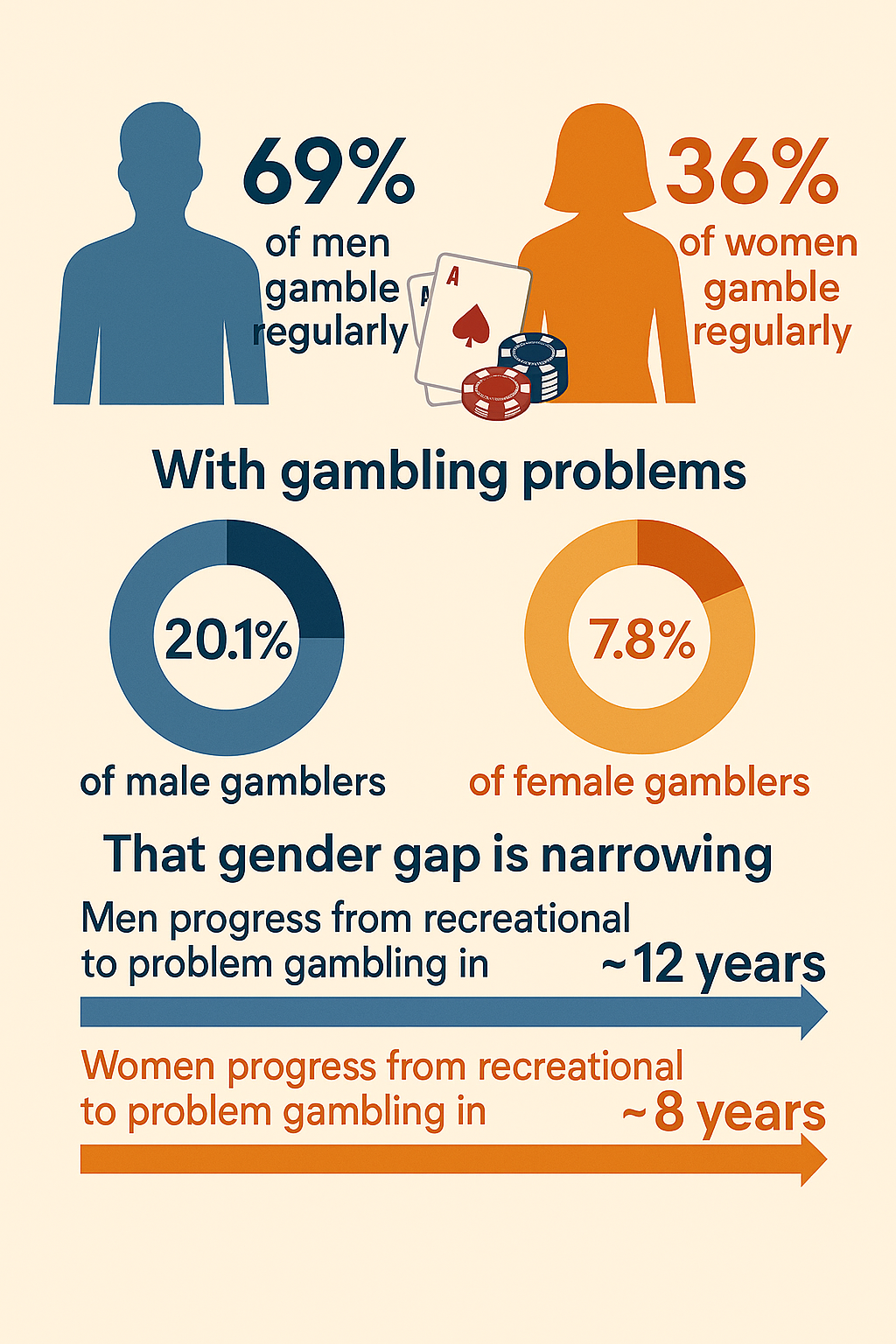
If this trend continues in the future, it is only a matter of time until women catch up to men in problematic gambling rates. The numbers mentioned above also hint at women having bigger problems keeping their gambling habit in check over time, indicating a possible high-risk betting tendency development. The phenomenon of women's accelerated progression from recreational to problem gambling is often referred to as the telescoping effect.
Now that we know that the gender gap of problematic gambling is rapidly shrinking, let’s try to break down which casino games are statistically more preferred by men and women.
In general, men are prone to prefer strategic gambling games, where the skill, experience, and knowledge of the participant play a role in the outcome. Casino table games, sports betting, and poker are all heavily male-dominated areas. According to BetHQ, 76.5% of horse/sports betting is dominated by men, while men also hold 78.4% of active sports betting accounts.
Statistically, women tend to give more preference to chance-based wagering, such as electronic gaming machines, bingo, and scratch cards. Some sources also suggest that women are more likely to play online casino games than men, including traditional table options like roulette, where players can bet roulette for real money from the comfort of their homes. What's also interesting is that bingo shows 67.6% female participation versus 32.4% male participation.
We believe that gender preferences in casino game choices may be indicative of a general male and female drive to participate in gambling activities. Men seem to enjoy the competitiveness and adrenaline rush usually associated with sports betting and poker. In contrast, women seem to treat themselves to gambling as a form of escapism, when they can relax after a hard day, turn their brain off and enjoy a slot of their liking.
Let’s take it one step further and look at a few studies on the gender difference in the context of gambling, scientifically speaking.
Research using the Human Connectome Project (968 subjects) reveals sex differences in neural responses to reward and punishment. Men and women show different activation patterns in brain regions associated with reward processing and impulse control.
If we get a little more nerdy, men exhibit stronger activation in the left lateral prefrontal cortex (lPFC) during reward processing. This region of the brain governs cognitive control and strategic decision making, aligning with male preference for skill-based gambling. Women, in turn, show heightened activation in the right dorsal anterior cingulate cortex (dACC) and angular gyrus during reward anticipation. These areas regulate emotional salience and attentional processing, aligning with female preference for chance-based games and immediate rewards.
Meta-analysis of the Iowa Gambling Task shows men consistently outperform women in decision-making scenarios that mirror gambling situations. This suggests fundamental differences in how men and women process risk and reward information, further supporting the findings made during the Human Connectome Project.
Here are a few other noteworthy facts associated with the way we’re wired: women display higher psychological distress when experiencing gambling problems, which leads to higher guilt and shame levels related to the issue. At the same time, men show a greater perceived inability to stop gambling in some groups.
As far as research suggests, we can conclude that male and female neurobiologies are different, and they play a massive role in each gender’s response to participation in gambling activities.
In this section, we will look at how much an average male gambler spends on his habit versus how much an average female gambler does. We will also try to identify the main harm patterns associated with problematic gambling in the context of gender.
According to iGB, an average UK male gambler's monthly deposit is £24.37 vs £16.69 for a female. Consequently, the male withdrawal amounts are also higher, averaging at £116.95 vs £91.42 for a female monthly.
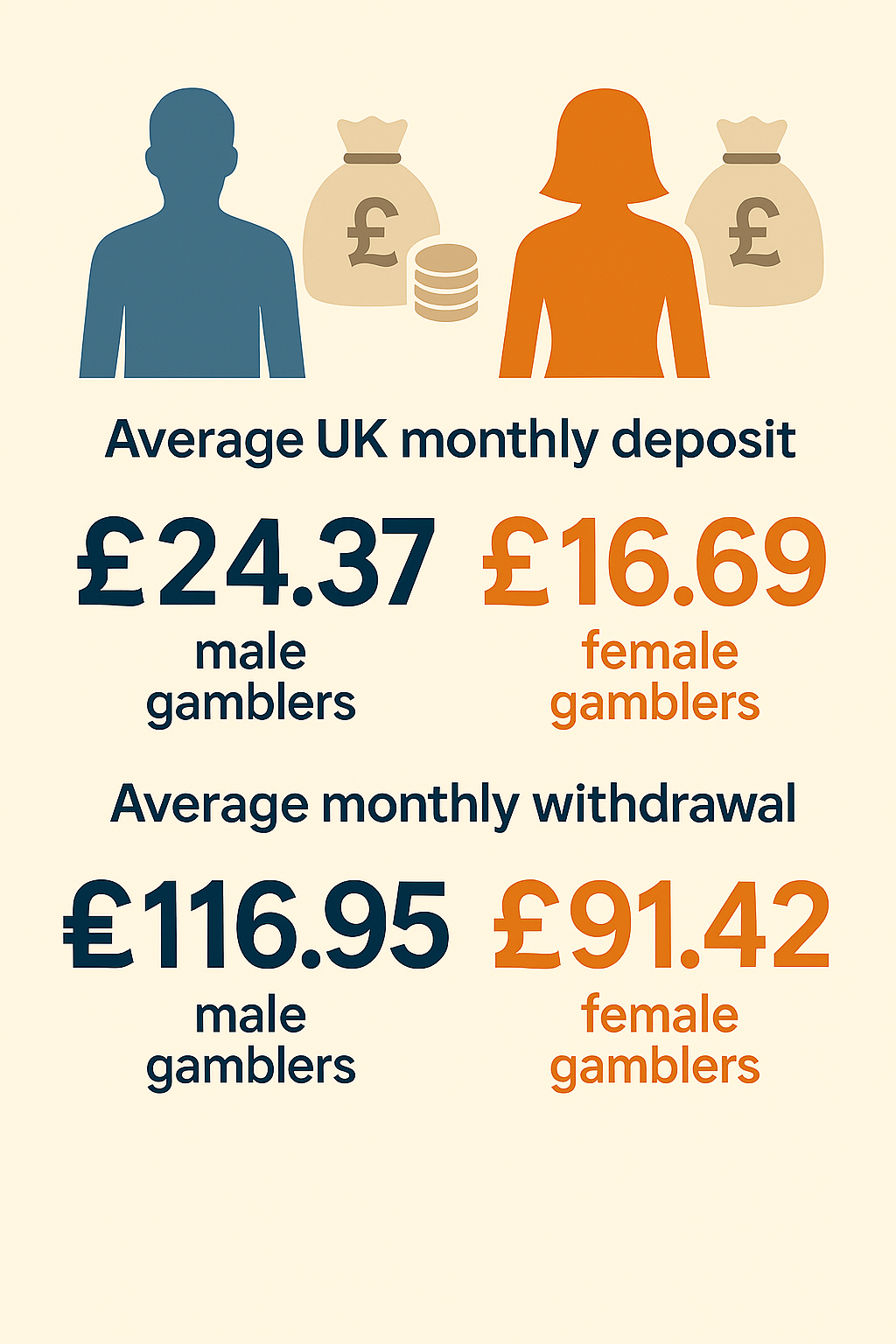
In terms of harmful patterns courtesy of problematic gambling, men are more likely to end up on the street due to their habit, as well as lose educational opportunities. At the same time, women are more likely to use credit card advances to fund their habit.
As far as we can see, the amount that average male and female gamblers spend on their casino-related fun is proportionate to each other, even though men spend more money monthly. This is likely due to a 31% deficit in the average UK female gambler’s salary when compared to her male counterparts.
After going through all of this evidence base, there is only one question left to answer. Please note that this is our personal opinion, and that answering such a vague question definitively is beyond our competence. With that being said, based on the research we’ve conducted, we believe that as of June 2025, men are the “riskier” gender in gambling. Even though the gender gap is shrinking fast, there are still twice as many men gambling as women, and the same rule applies to problematic gambling rates as well.
However, many sources suggest that female gambling participation is increasing faster than that of men, and that younger women show different gambling patterns than older cohorts. Hence, the future is hard to predict. Considering the fact that many casinos (especially online ones) started spending fortunes each year on female-targeted marketing, who knows, maybe in 10-20 years women will catch up or even overtake men in terms of gambling riskiness.
Roulette Guides. Casino News. Weekly Updates.
 @
@

 3 min read
10.16.2025
3 min read
10.16.2025
 5 min read
07.21.2025
5 min read
07.21.2025

 10 min read
07.09.2025
10 min read
07.09.2025
 5 min read
07.08.2025
5 min read
07.08.2025
 3 min read
06.12.2025
3 min read
06.12.2025
 10 min read
06.10.2025
10 min read
06.10.2025
 5 min read
06.04.2025
5 min read
06.04.2025
 10 min read
06.04.2025
10 min read
06.04.2025
 10 min read
06.03.2025
10 min read
06.03.2025
 10 min read
05.28.2025
10 min read
05.28.2025
 5 min read
05.28.2025
5 min read
05.28.2025
 5 min read
05.16.2025
5 min read
05.16.2025

 10 min read
05.13.2025
10 min read
05.13.2025
 5 min read
05.05.2025
5 min read
05.05.2025
 10 min read
04.30.2025
10 min read
04.30.2025

 10 min read
04.23.2025
10 min read
04.23.2025
 5 min read
04.14.2025
5 min read
04.14.2025
 10 min read
04.11.2025
10 min read
04.11.2025
 12 min read
04.04.2025
12 min read
04.04.2025
 5 min read
03.27.2025
5 min read
03.27.2025
 10 min read
03.13.2025
10 min read
03.13.2025

You finished <b>[place]</b> among [total_players] players. Tournament results are calculated based on UTC time.

You finished <b>[place]</b> among [total_players] players. Tournament results are calculated based on UTC time.

It is great to see that gambling remains just entertainment! To keep it that way:
Continue playing wisely – you are a good example of a healthy approach to gambling.

It seems you are doing fine, but small red flags are already appearing. Try:
The sooner you act, the easier it is to stay in control.

The test showed that gambling might be becoming a problem. What you can do right now:
You are not alone. Help works, and the first step changes more than it seems.


