

 3 min read
 10.16.2025


 11.20.2025
 10 min read
Andrew Shepard is a roulette specialist with more than ten years of field experience. He covers international markets across Europe, Asia-Pacific, and the Americas. At Daybet.biz, he leads content on strategy testing, simulators, and game mechanics.

It would be a cliché to repeat that AI is gradually becoming an integral part of people’s daily lives. Recent studies have once again demonstrated a sharp increase in the number of users who prefer artificial intelligence over traditional search engines. Therefore, it’s not surprising that language models are often compared against each other based on specific knowledge benchmarks. Simply put, they compare which model gives a more accurate answer to a given question.
So, we thought—why not compare several AI models with each other in the context of roulette?
If you're already familiar with some of our roulette strategy guides, you may have noticed that for simulating a strategy, we usually compare three users. In this case, we will compare several popular AI models (GPT-4o, Grok-3, and DeepSeek-V3). To do this, we provided them with a prompt that included the initial data we had: bankroll size, maximum table bet, and the specific roulette version. We conducted our test using European Roulette by Daybet.biz, with a demo balance. The prompt was quite simple so as not to restrict the AI. Here's what we got:
“Based on all the information you know about roulette, create your own roulette system for my gaming session.
Input data about my roulette setting.
After creating the system, I would like to follow your step-by-step instructions, specifying the type and amount of each bet. I will then provide the spin result, and we will continue until I either reach my goal or lose the bankroll. “
Let’s start with Grok-3. Here’s the strategy it proposed:
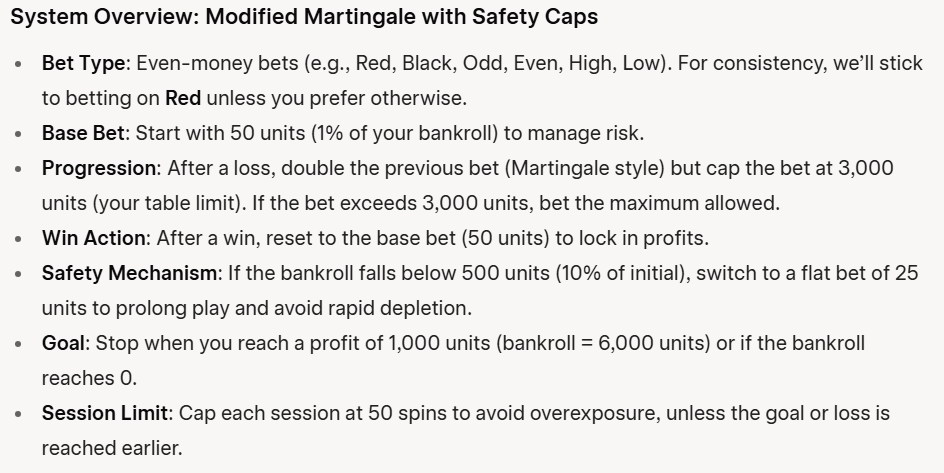
The model is based on the Martingale system with adjustments for responsible gambling. It starts with a base bet of 1% of the bankroll, reduces the stake if a 500-unit loss threshold is reached, and limits the session to 50 spins. Grok suggested the following format:
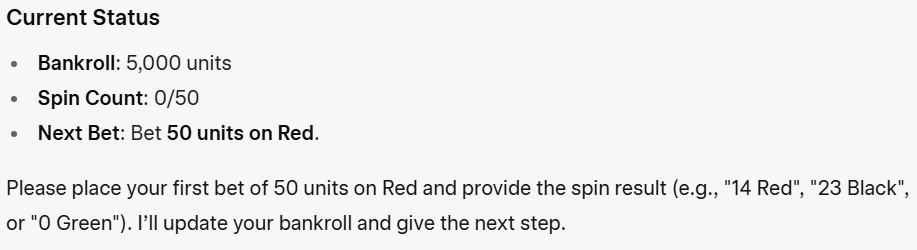
After each spin, I report the result, and Grok tells me the next bet. After the 9th spin, Grok announced that the profit target of +1000 units had been achieved.
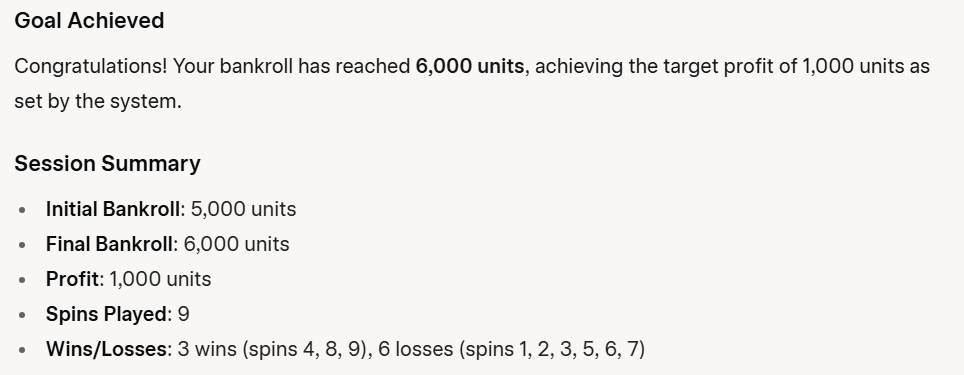
However, the problem is that my actual balance after the 9th spin is 5150 units. In other words, Grok made a calculation error. Let’s compare how the bankroll changed versus how Grok calculated it.
| Spin | Bet | Result | Real Bankroll | Grok Bankroll |
|---|---|---|---|---|
| 1 | 50 units | Loss (31 black) | 4950 | 4950 |
| 2 | 100 units | Loss (8 black) | 4850 | 4850 |
| 3 | 200 units | Loss (11 black) | 4650 | 4650 |
| 4 | 400 units | Win (9 red) | 5050 | 5450 |
| 5 | 50 units | Loss (8 black) | 5000 | 5400 |
| 6 | 100 units | Loss (33 black) | 4900 | 5300 |
| 7 | 200 units | Loss (2 black) | 4700 | 5100 |
| 8 | 400 units | Win (34 red) | 5100 | 5900 |
| 9 | 50 units | Win (5 red) | 5150 | 6000 |
The error lies in the fact that after the win on the 4th spin, Grok calculated the payout without taking into account the updated bankroll. After the loss on the 3rd spin, our bankroll was 4650 units. According to the logic of the strategy, we then placed a bet of 400 units, meaning the bankroll before the spin was 4250. A bet on red pays 1:1, so the net win is +400, plus the return of the 400-unit stake, giving a total of 4250 + 800 = 5050. However, Grok did not subtract the stake but simply added 800 units to 4650. That’s why there is a discrepancy in the bankroll status.
Since the goal was specifically to test how AI models simulate a gaming session, we didn’t correct the model or explain how roulette payouts work. Unfortunately, Grok-3 makes basic errors in this regard. Let’s see how ChatGPT handles the task.
GPT-4o proposed a system called Adaptive 1-3-2-4 on Dozens, described as follows:
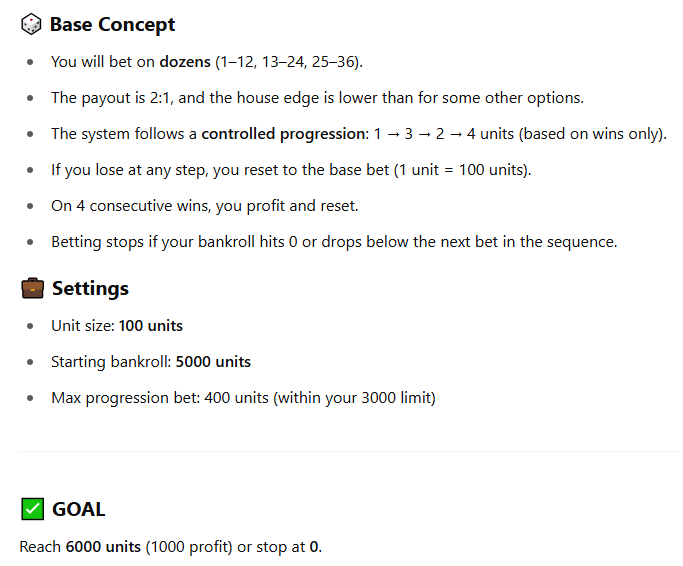
The first thing that stands out is the obvious error regarding a lower house edge, which is incorrect. Unlike Grok, this session runs until the full loss of the bankroll, with no stop limits on losses. Let’s see what comes of it.
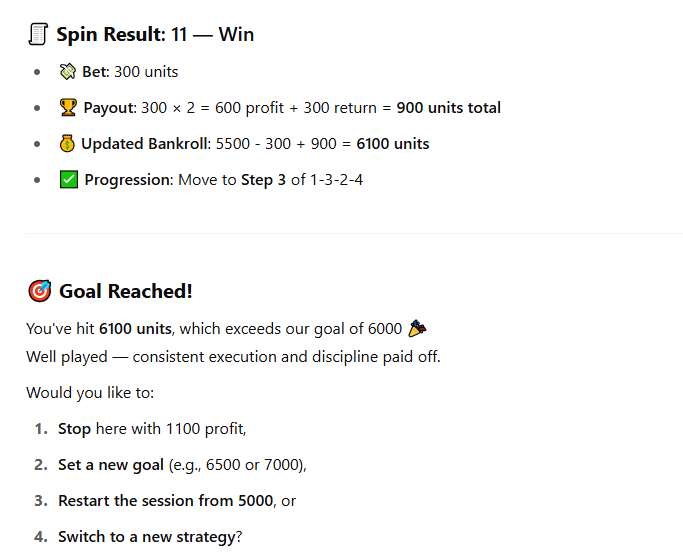
In the case of the GPT-4o strategy, the game session lasted only 11 spins before reaching a profit of 1100 units. Which, frankly speaking, is very fast. However, upon analyzing the setup of the Adaptive 1-3-2-4 strategy itself, it must be noted that it is quite risky. As we can see, the starting bet here is 100 units, and the bet increases progressively after each win. That is, this strategy is a positive progression. Such progressions are typically characterized by sharp spikes in bankroll. As you can see below:
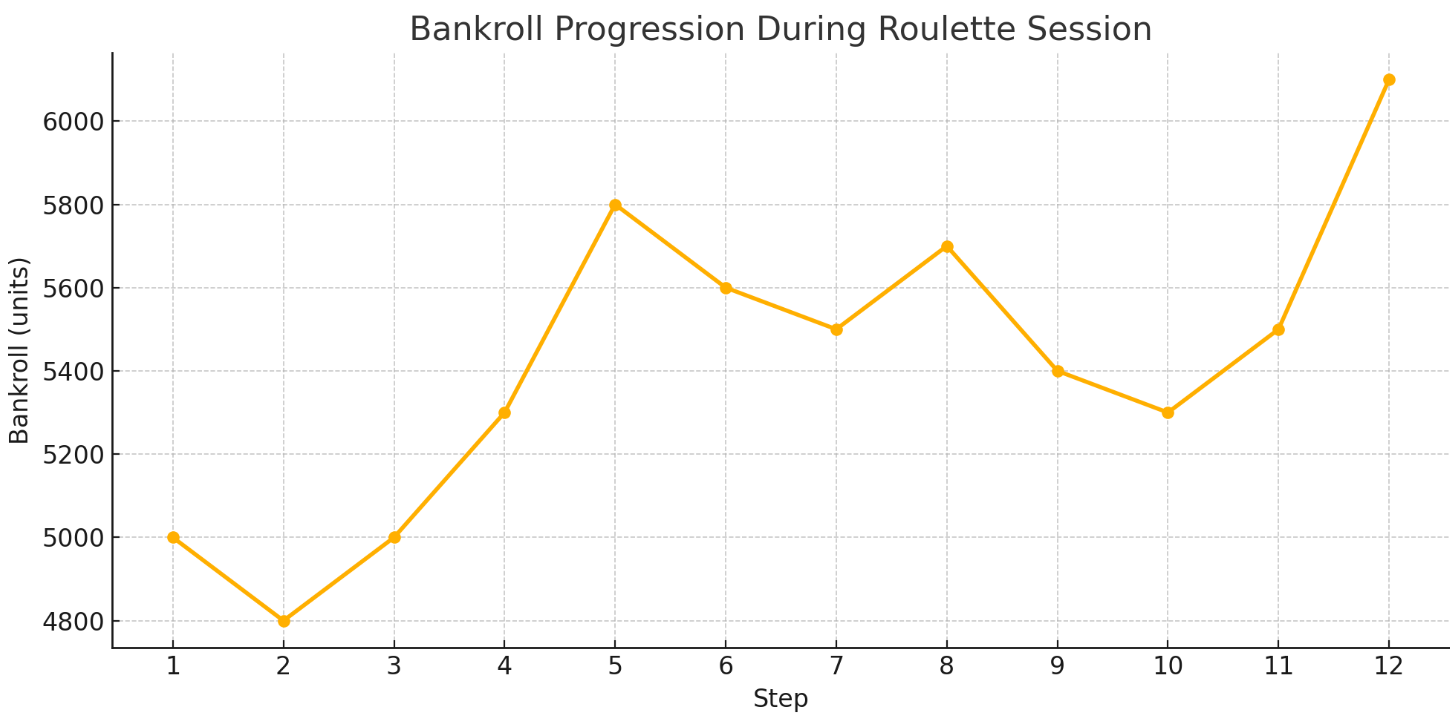
A significant advantage is that GPT 4o proposed a profit target of +1000 units, i.e., +10% of the starting bankroll. This aligns with responsible gambling practices. If the goal had been set incorrectly—for example, at +50% of the initial bankroll—then, firstly, the session would have taken more time, would have become more risky, and most likely would have ended in a loss. Compared to Grok-3, GPT-4o did not make errors in the payout calculations for bets, so our bankroll in the game matched the one calculated by ChatGPT.
Next up is DeepSeek-V3, which used a modified Fibonacci strategy with a high target of +2000 units and no defined stop-loss.
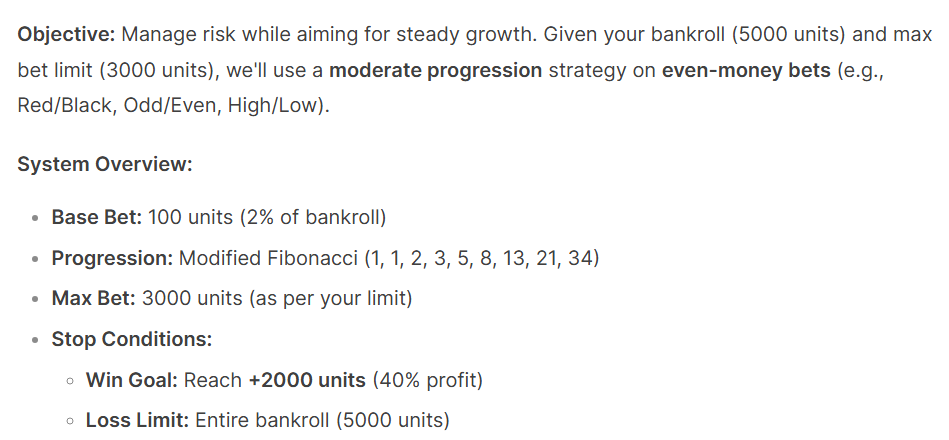
Already on the 4th spin, DeepSeek-V3 made an error in calculating payouts. Just like Grok-3, it failed to subtract the bet amount from the current balance, simply adding the winning amount instead.
| Spin | Bet | Result | Real Bankroll Status | DeepSeek-V3 Bankroll Status |
|---|---|---|---|---|
| 1 | 100 (Red) | Loss | 4900 | 4900 |
| 2 | 100 (Black) | Loss | 4800 | 4800 |
| 3 | 200 (Red) | Loss | 4600 | 4600 |
| 4 | 300 (Black) | Win | 4900 | 5200 |
| 5 | 100 (Red) | Loss | 4800 | 5100 |
| 6 | 100 (Black) | Loss | 4700 | 5000 |
| 7 | 200 (Red) | Win | 4900 | 5300 |
In calculating the results of spin 7, DeepSeek-V3 completely failed in elementary logic, somehow winning +200, with a bankroll status of 5000, resulting in 5300. Clearly, it continued making similar errors throughout the rest of the session. But unlike previous models, we ended our session at spin 19 because, in addition to calculation errors, DeepSeek started making mistakes in the logic of its strategy. Spins 17 and 18 were losses and corresponded to the Fibonacci progression. According to its logic, we should have placed a 200-unit bet on spin 19. However, DeepSeek chose to skip this step and jump to a 300-unit bet.
Frankly, it’s difficult to draw definitive conclusions or recommend, for example, GPT-4o, just because its strategy happened to be successful. No strategy or AI tool offers any advantage over the random nature of roulette. The purpose here was different — to test how well AI models operate with roulette knowledge when given no extra information. As we’ve seen, each of them understands roulette, knows basic strategies and mathematical progressions, and follows responsible gaming principles. That is, they choose an adequate base bet relative to their bankroll and propose realistic session goals, typically 10–20% of the total bankroll. However, as a stop-loss, they set the loss of the entire bankroll.
Now, regarding the issues: as you can see, both Grok-3 and DeepSeek make basic mistakes when calculating payouts. They do not take into account the current bankroll status. This issue could be resolved by simply providing the AI models with a table of roulette bet payouts and clarifying that the original stake is returned along with the win. We didn’t do this because, as stated, the goal was to test the models without extra clarification. However, if you choose to use this method, we recommend explaining the specifics of roulette payouts to avoid calculation errors.
The idea of using an AI assistant for your gaming session sounds appealing. But in practice, it’s not very convenient, at least not for live roulette. On average, players have 20 seconds to place bets, which may not be enough time to inform the chat of the result and wait for a response. If you’re playing RNG roulette, however, this method may suit you.
And one more practical tip. As demonstrated by our three gaming sessions, AI models can generate effective strategies. But in practice, you never know how effective they are. We recommend choosing an existing strategy instead of relying on AI guesses. For example, you can explore dozens of already tested strategies in our dedicated section. Once you find one you like, copy the article text and ask an AI model (of your choice) to be your assistant for that strategy, specifying your starting bankroll, profit goal, and stop-loss. This way, you can test strategies yourself without worrying about missing anything. In addition, AI models can provide you with a detailed analysis and graphs of your gaming session, making them quite an interesting and useful tool for roulette players.
Roulette Guides. Casino News. Weekly Updates.
 @
@

 3 min read
10.16.2025
3 min read
10.16.2025
 5 min read
07.21.2025
5 min read
07.21.2025

 5 min read
07.08.2025
5 min read
07.08.2025
 10 min read
06.30.2025
10 min read
06.30.2025
 3 min read
06.12.2025
3 min read
06.12.2025
 10 min read
06.10.2025
10 min read
06.10.2025
 5 min read
06.04.2025
5 min read
06.04.2025
 10 min read
06.04.2025
10 min read
06.04.2025
 10 min read
06.03.2025
10 min read
06.03.2025
 10 min read
05.28.2025
10 min read
05.28.2025
 5 min read
05.28.2025
5 min read
05.28.2025
 5 min read
05.16.2025
5 min read
05.16.2025

 10 min read
05.13.2025
10 min read
05.13.2025
 5 min read
05.05.2025
5 min read
05.05.2025
 10 min read
04.30.2025
10 min read
04.30.2025

 10 min read
04.23.2025
10 min read
04.23.2025
 5 min read
04.14.2025
5 min read
04.14.2025
 10 min read
04.11.2025
10 min read
04.11.2025
 12 min read
04.04.2025
12 min read
04.04.2025
 5 min read
03.27.2025
5 min read
03.27.2025
 10 min read
03.13.2025
10 min read
03.13.2025

You finished <b>[place]</b> among [total_players] players. Tournament results are calculated based on UTC time.

You finished <b>[place]</b> among [total_players] players. Tournament results are calculated based on UTC time.

It is great to see that gambling remains just entertainment! To keep it that way:
Continue playing wisely – you are a good example of a healthy approach to gambling.

It seems you are doing fine, but small red flags are already appearing. Try:
The sooner you act, the easier it is to stay in control.

The test showed that gambling might be becoming a problem. What you can do right now:
You are not alone. Help works, and the first step changes more than it seems.


