


 3 min read
 10.16.2025


 05.13.2025
 10 min read
Andrew Shepard is a roulette specialist with more than ten years of field experience. He covers international markets across Europe, Asia-Pacific, and the Americas. At Daybet.biz, he leads content on strategy testing, simulators, and game mechanics.

The global online gambling market has existed for decades. Since its inception as a niche concept in the mid-1990s, it has undergone significant transformations, becoming a multi-billion-dollar industry. Its scope covers online casinos and betting exchanges that provide all sorts of wagering, casino games, and lottery services. In this article, we will look at how the online gambling market came around, its current state, its prospects, and what challenges are on the horizon.
Before we discuss the prospects and challenges, though, let's set the stage by covering a few significant historical milestones in the development of the global online gambling market, from its foundation to its current state.
1993: Curacao enacted the National Ordinance on Offshore Games of Hazard, one of the earliest online gambling legislations, positioning itself as a progressive jurisdiction for the infant iGaming sphere. They will issue their first license soon after, in 1996.
1995: Liechtenstein International Lottery, the first iGaming platform, was launched this year. It pioneered the purchase of lottery tickets over the internet, creating a precedent for safe, secure, and regulated online gambling.
1996: The digital era of online casinos started with the launch of InterCasino in Antigua. William "Billy" Scott founded this real-money casino powered by CryptoLogic software.
1997: This was the year the online gambling industry saw its first big boom in popularity. In 365 days, the number of gambling sites skyrocketed from just 15 to over 200.
1998: According to a report by Frost and Sullivan, the online gambling market's revenues have exceeded $830 million this year alone. 1998 is also prominent due to the launch of Planet Poker, the platform that pioneered real-money online poker, enabling gamblers to play against each other via the internet.
2000s: This market development period is mainly characterized by the poker boom of 2003-2006, escalated by Chris Moneymaker’s 2003 WSOP victory and other televised poker events, which drew millions to online platforms like PokerStars. The emergence of iOS (2007) and Android (2008) smartphones made gambling more accessible, stimulating revenues from $8.5 billion in 2004 to $21 billion by 2008. The first online live dealer games also emerged during this period, with Playtech introducing its live dealer platform in 2003 and other providers following suit in the mid-2000s. Finally, Betfair and Flutter (the first online betting exchanges) launched in 2000, revolutionizing the market with their peer-to-peer wagering model.
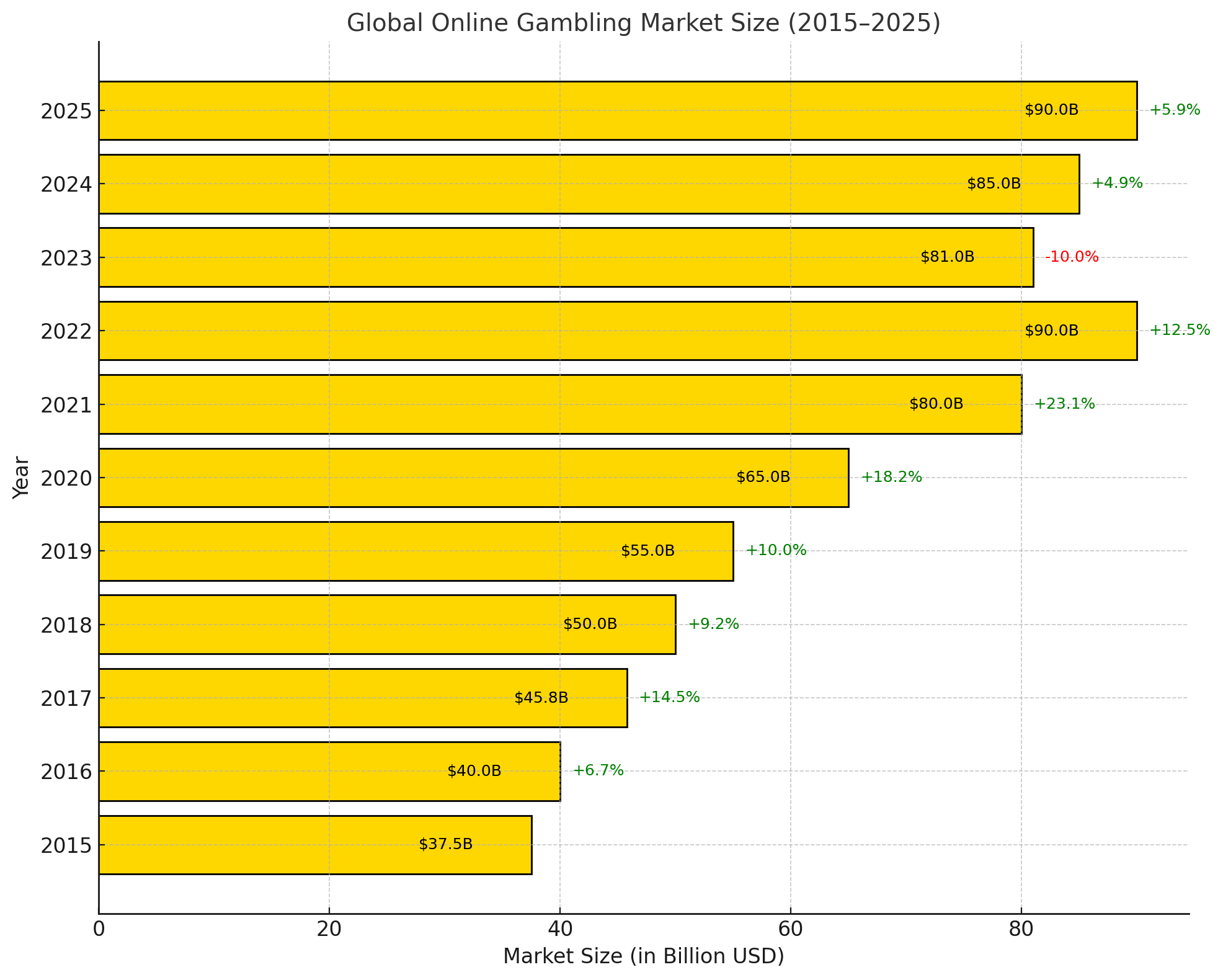
2015: According to H2 Gambling Capital, the global online gambling market reached industry maturity this year by passing the $37.5 billion threshold in gross gaming revenue (GGR).
2020: Unsurprisingly, the COVID-19 pandemic caused, among other things, a 43% increase in online poker attendance in the U.S. during lockdowns. New Jersey reported a surge in revenues by 90.9% in March 2020.
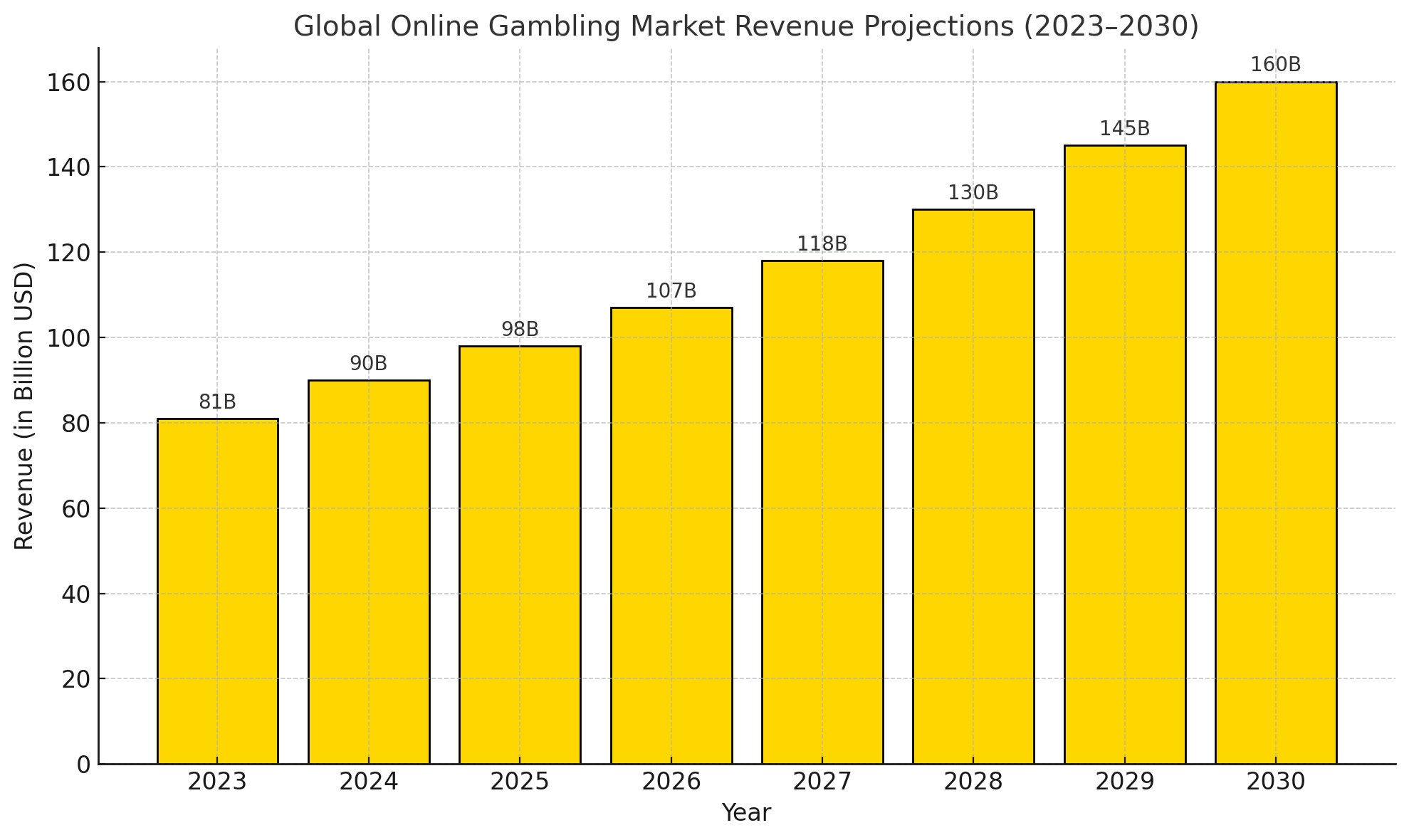
2023: The global online gambling market reached $81 billion this year, representing a 10% compound annual growth rate (CAGR) from 2018 to 2023. This achievement is credited to post-COVID digitalization and regulatory breakthroughs in Europe and the U.S.
Now that we've covered some of the history of the global online gambling market, let's talk about its current state. What is certain is that it is prospering, valued between $87.69 billion and $111.44 billion as of 2025. Improvements in payment technologies, increased smartphone penetration, and the spread of regulatory frameworks throughout different regions are the main factors causing said growth. But what about the numbers exactly?
Please note that all the information below was gathered from reputable industry sources. Still, the exact numerical values may differ from study to study since each separate source operates within the parameters of its own data collection streams.
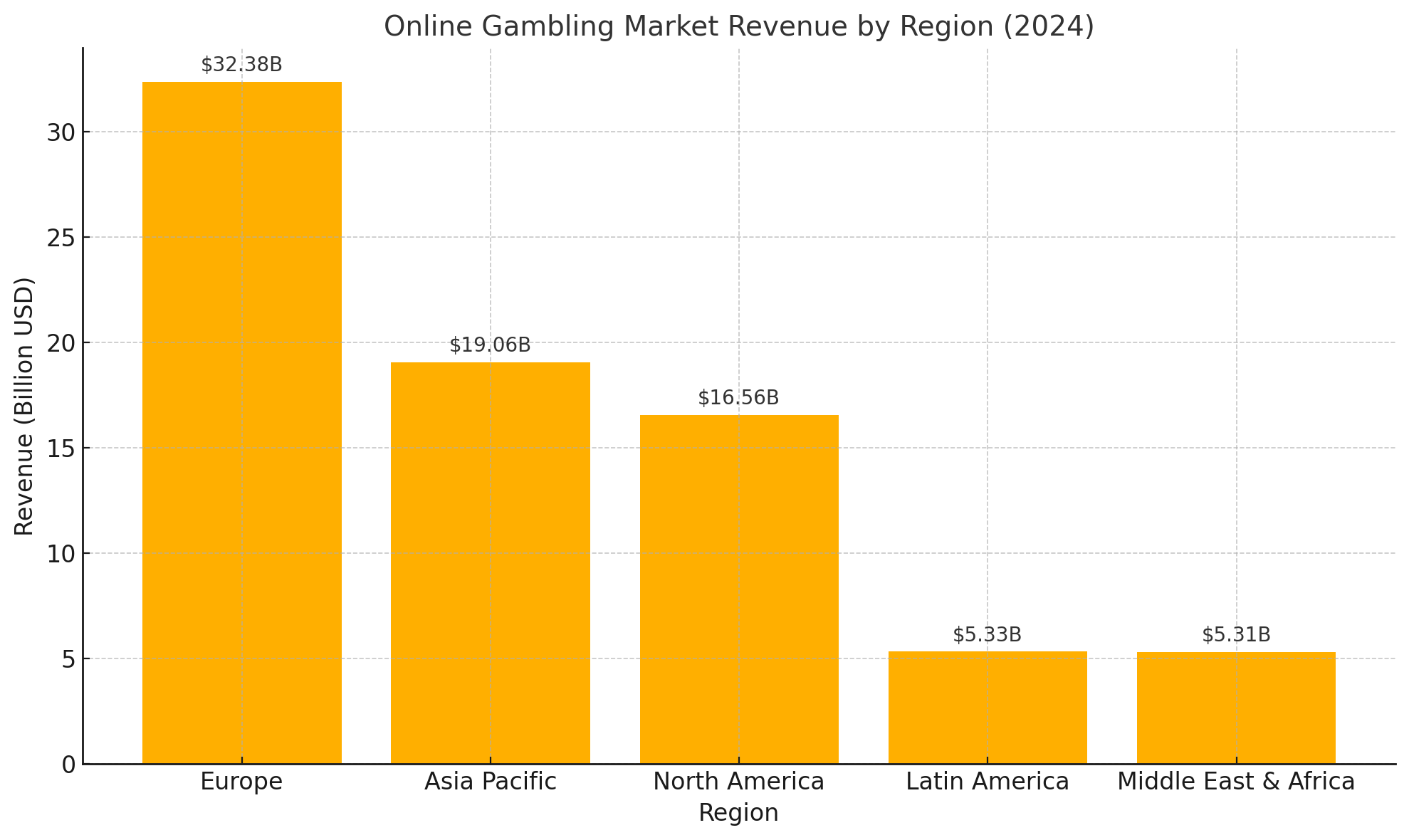
According to a 2024 study done by Grand View Research, Europe is the leading region in the global online gambling market with a 41.2% share or $32.38 billion in revenue. The leadership is attributed to seasoned regulatory frameworks in countries like the U.K., France, and Germany. Asia Pacific comes in second with $19.06 billion (24.2%), fueled by an increased digital spread in Japan and India. The North American region earns third place with a 21.1% share ($16.56 billion) thanks to a state-level legalization trend. Latin America and the Middle East & Africa are emerging markets worth $5.33 billion (6.8%) and $5.31 billion (6.8%), respectively.
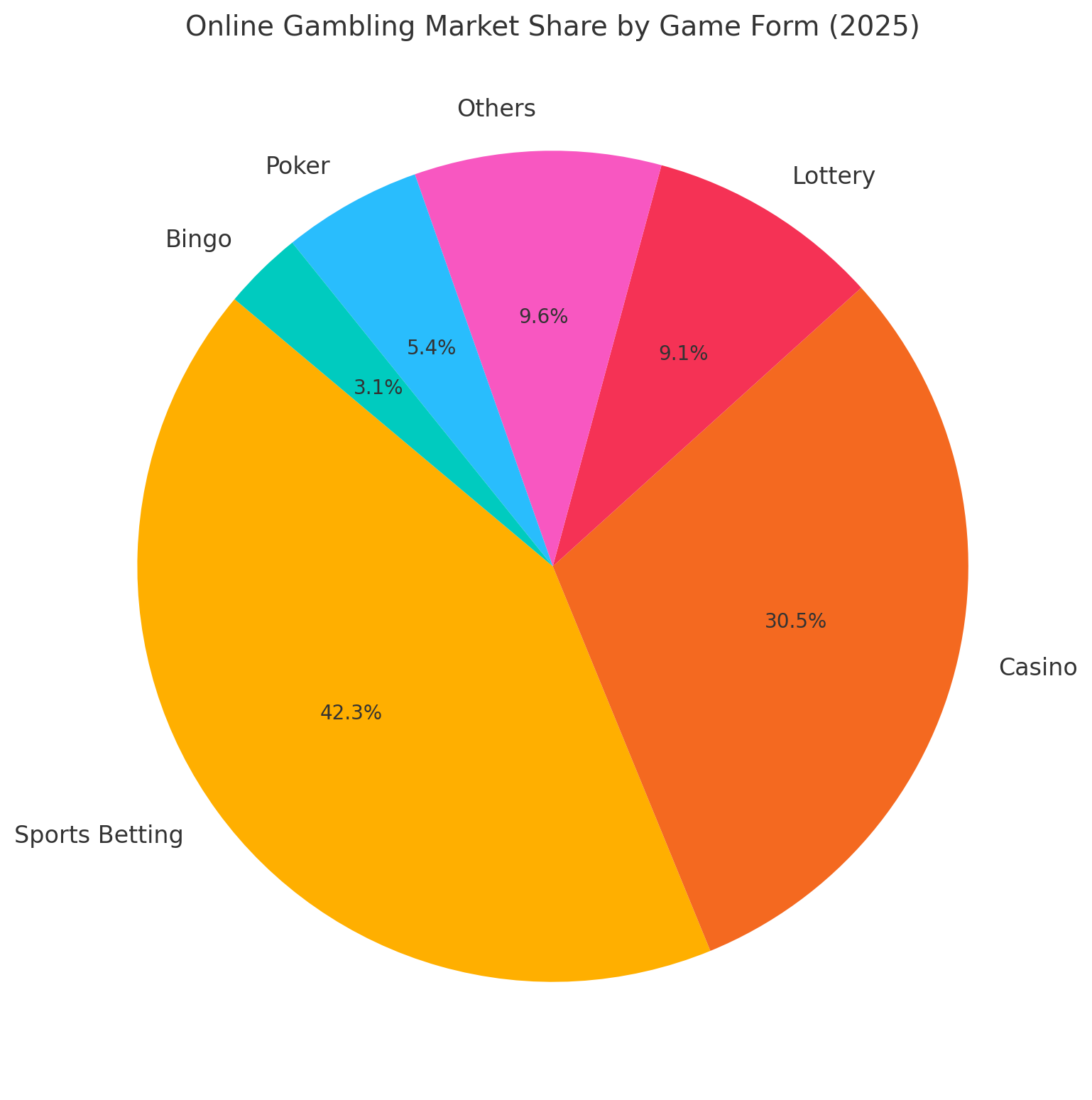
According to a report by Custom Market Insights, by 2025, the sports betting segment will hold the largest share of the entire market at 42.3%. Its rapid growth, projected at a CAGR of 13.2%, will be fueled by factors such as AI-powered personalization and the legalization of sports betting in many new regions. Online casinos will follow with a 30.5% share, driven by engaging live dealer games and a growing emphasis on smartphone technology. The lottery segment will account for 9.1% of the market. Virtual and fantasy sports, grouped under "Others," will gain momentum due to innovations in AR and VR, capturing a 9.6% share. Skill-based online poker and the niche-appealing online bingo segment will round out the list with 5.4% and 3.1% market shares, respectively.
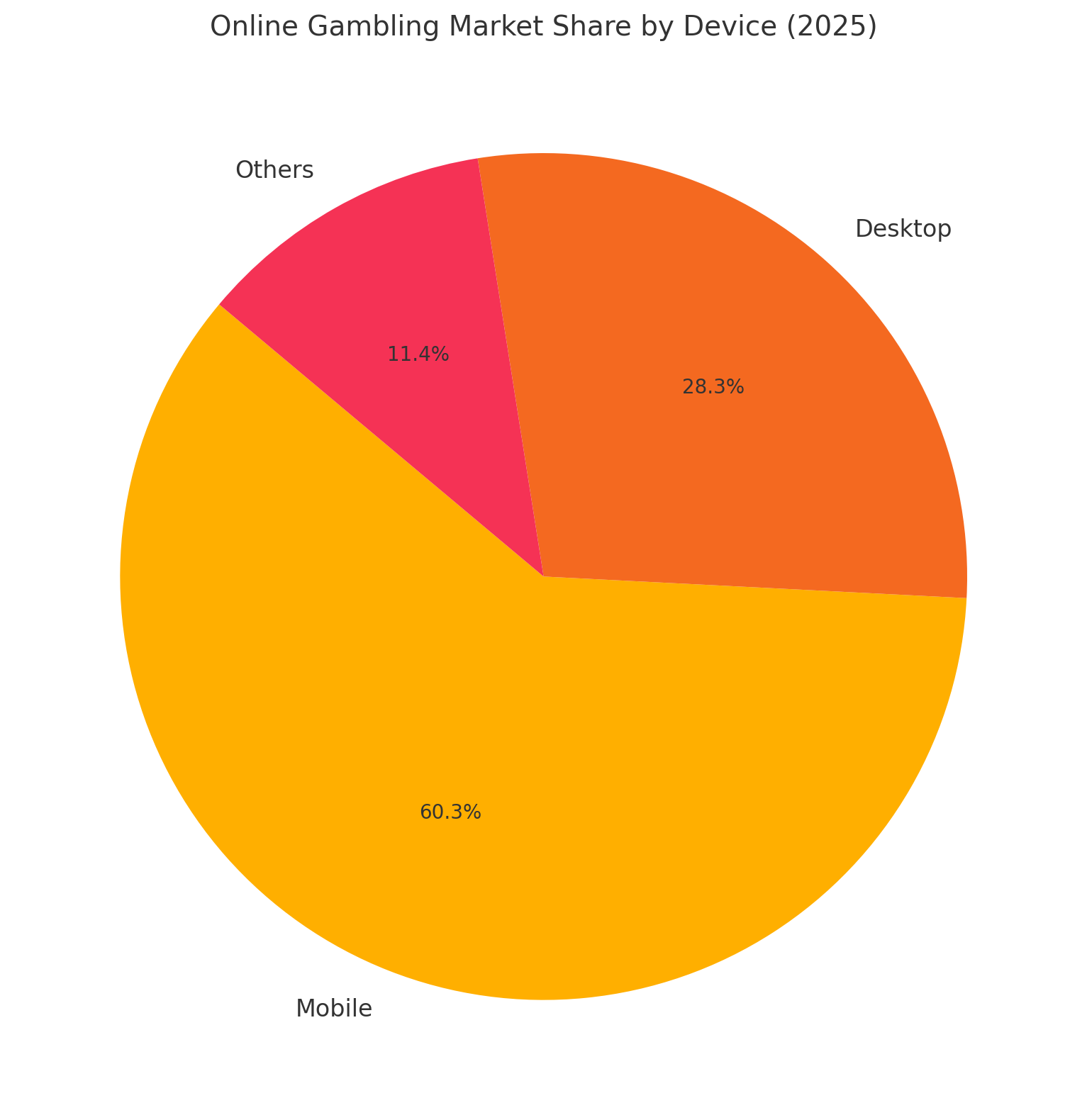
Custom Market Insights study also estimates that mobile devices will dominate the online gambling market in 2025, accounting for 60.3% of total traffic and continuing to grow at a CAGR of 14.6%. This growth will be primarily driven by expanding internet access in emerging markets, with live streaming and in-play betting features boosting player engagement. Desktops will follow with a solid 28.3% share. Although usage is expected to decline slightly compared to the previous year, experienced gamblers will continue to favor desktops for their superior processing capabilities and more immersive live game experiences. The "Others" category—mainly smart TVs and tablets—will comprise the remaining 11.4% of the traffic. Despite the category’s niche status, some players prefer tablets and TVs for convenience and larger screen sizes.
The global online gambling market is growing exponentially, in large part thanks to the accessibility provided by smartphones, the spread of which has surged in many regions around the world, especially in developing ones. Most modern brands quickly adapted to the trend of gambling and betting going mobile. Now, users can access their favorite platforms from anywhere, anytime, a feature attracting a new player base. Sports betting apps, in particular, are a seasoned money maker because they allow people to gamble while watching live events as they unfold.
Besides already being a steady revenue stream, sports betting only keeps expanding, solidifying itself as another primary growth driver for the market. Globally, betting activity surges where huge sports events run, such as the NFL, IPL, or the FIFA World Cup. Additionally, a more widespread regulatory normalization of sports betting in various new jurisdictions, such as the 2018 Supreme Court ruling in the U.S., only further fuels this trend. With the intent to control the tax revenue potential, not only betting, but also online gambling is being legalized and regulated by many more governments worldwide.
Moreover, technological breakthroughs are the foundation of the online gambling market's growth. Blockchain, big data, and AI strengthen odds-setting, security, and payment systems, as well as improve personalization. Finally, live dealer games in online casinos are experiencing a jump in popularity due to their immersiveness, providing an experience similar to a land-based casino. All the mentioned growth factors are thought to be the pillars of the market's sustained growth in the near future.
The consistent growth of the global online gambling industry does come with its drawbacks, which come in the form of threats to market integrity and consumer safety. The most significant challenge is the rapid spread of black and gray markets that distract players from regulated platforms, undermining the industry's effort to guarantee safe gambling practices. H2 Gambling Capital estimates that 21% of all European online gambling activity happened outside of the legal space back in 2023, causing €13 billion in lost regulated revenue. AGA also reports that the U.S. is losing $13 billion in tax revenue annually due to illicit online gambling activities. Illegal platforms exploit gaps in regulation, often neglecting basic consumer safety protocols.
Besides unregulated competition, regulatory uncertainty and fragmentation are other burdens on operators' shoulders. Global brands must adjust to ever-evolving tax rates, compliance protocols, and licensing regulations. At the same time, North American firms must modify their practices depending on state-specific laws, which often differ immensely. Like many online industries, online gambling platforms are no strangers to cybersecurity threats, which usually happen with the intent to steal players' identities to commit financial fraud. Smaller operators are especially susceptible to such threats from professional scammers, since their defense is usually flawed. Not to mention the industry trend of pressuring the brands to enforce firm player protection protocols concerning, but not limited to, identity verification and addiction prevention.
Lastly, uncontrollable technological race and market saturation present overlapping threats. As the demand for innovative games grows, platforms must make massive investments in technology and software, or they risk becoming outdated. Also, seasoned online gambling jurisdictions function within the parameters of immense competition and expensive customer acquisition, which drives some platforms to exit, for instance, Kindred Group’s 2024 withdrawal from the U.S. market due to high margin volatility. In conjunction, all of the outlined threats point toward the need for more coordinated regulation and a step forward to more sustainable business models.
Europe is home to one of the oldest and most strictly regulated online gambling markets in the world. Each country has the right to regulate its market independently, with most opting for multi-licensing frameworks, like the U.K., Netherlands, and Sweden. These frameworks enable private brands to operate under firm consumer protection protocols in said countries. Germany and the Netherlands recently adjusted their markets by implementing centralized licensing systems. Other countries, like Norway and Finland, still have state-run monopolies, though Finland is moving toward a multi-license model. The UK Gambling Commission and Malta Gaming Authority are the primary regulators in the region, tasked with scrutiny over anti-money laundering, player safety, and advertising. Europe is, for the most part, a welcoming area for operators, but one should be ready to follow responsible gambling protocols meticulously.
The Asia-Pacific region is immensely fragmented, encompassing regulated markets like Australia and the Philippines and jurisdictions that flatly ban online gambling, such as South Korea and China. Southeast Asian countries are highly against online gambling activities, often prohibiting access to offshore sites on their soil. However, Australia allows legal online sports betting but shuts down online casinos due to rigorous scrutiny from the ACMA. The Philippines is considered to be the most liberal APAC jurisdiction since it permits both domestic and offshore online operators. Countries such as India, Singapore, and Japan are exploring the idea, but online gambling operations are highly limited, often being state-run and greatly controlled. Overall, the region is considered to be very conservative regarding online gambling legislation, but it is showing potential in terms of upcoming reform.
The U.S. and Canada are the only two online gambling jurisdictions in the North American region. The U.S. runs on a fragmented state-by-state regulation system, and Canada's system is managed provincially. As of 2025, 30 states, plus DC and Puerto Rico, have legalized online sports betting. However, online casinos are not as common, with only Michigan and New Jersey permitting such activity. Ontario tops the iGaming charts in Canada with a competitive market; the same can't be said about the remaining provinces, which are highly dependent upon platforms under state control. Both countries are showing a permissive trend in regulation, with Ontario's AGCO and New Jersey's DGE being at the spearhead of licensing and enforcement.
Latin America is one of the most promising emerging regions, rapidly transforming from an unregulated to a structured market format. Colombia was the first country in the region to permit online gambling in 2016. Countries like Argentina and Brazil have legalized online sports betting to a certain degree, while Chile and Peru are slowly but steadily following in their footsteps. Mexico also allows online gambling operations on its soil, but the license acquisition process is notoriously thorny. The enforcement of safety practices is still not Latin America's strongest asset. Still, the general trend for regulation is present, with the reforms being led by regulators such as Brazil’s Ministry of Finance and Colombia’s Coljuegos.
Most Middle Eastern jurisdictions prohibit online gambling due to religious reasons, with the UAE and Israel being the only exceptions. The GCGRA federal regulator was recently formed by the former, which many believe to be a sign of further legalization. The landscape of Africa is diverse, with countries like Nigeria, Ghana, and Kenya accepting emerging regulatory frameworks for mobile sports betting. Similarly, South Africa licenses sportsbooks, but online casinos have no permission to operate in the country, a trend for the entirety of the African region. While the enforcement is rapidly spreading, black markets are persistently plaguing the continent, being considered a primary challenge for further development.
As of 2025, the online gambling industry is poised to grow faster than ever, especially in emerging markets across Latin America, Asia, and Africa, where digitalization and regulatory reformation present countless opportunities. Technological advancements in machine learning and AI are actively transforming risk management tactics, player engagement, and game design, all to the operators' benefit. While many challenges, such as cultural fit and regulatory compliance, remain, we argue that investment in innovation within the framework of strategic market entry provides an opportunity for considerable results. Building trust and loyalty will be key in contemporary customer acquisition and retention strategies.
Roulette Guides. Casino News. Weekly Updates.
 @
@

 3 min read
10.16.2025
3 min read
10.16.2025
 5 min read
07.21.2025
5 min read
07.21.2025

 10 min read
07.09.2025
10 min read
07.09.2025
 5 min read
07.08.2025
5 min read
07.08.2025
 10 min read
06.30.2025
10 min read
06.30.2025
 3 min read
06.12.2025
3 min read
06.12.2025
 10 min read
06.10.2025
10 min read
06.10.2025
 5 min read
06.04.2025
5 min read
06.04.2025
 10 min read
06.04.2025
10 min read
06.04.2025
 10 min read
06.03.2025
10 min read
06.03.2025
 10 min read
05.28.2025
10 min read
05.28.2025
 5 min read
05.28.2025
5 min read
05.28.2025
 5 min read
05.16.2025
5 min read
05.16.2025

 5 min read
05.05.2025
5 min read
05.05.2025
 10 min read
04.30.2025
10 min read
04.30.2025

 10 min read
04.23.2025
10 min read
04.23.2025
 5 min read
04.14.2025
5 min read
04.14.2025
 10 min read
04.11.2025
10 min read
04.11.2025
 12 min read
04.04.2025
12 min read
04.04.2025
 5 min read
03.27.2025
5 min read
03.27.2025
 10 min read
03.13.2025
10 min read
03.13.2025

You finished <b>[place]</b> among [total_players] players. Tournament results are calculated based on UTC time.

You finished <b>[place]</b> among [total_players] players. Tournament results are calculated based on UTC time.

It is great to see that gambling remains just entertainment! To keep it that way:
Continue playing wisely – you are a good example of a healthy approach to gambling.

It seems you are doing fine, but small red flags are already appearing. Try:
The sooner you act, the easier it is to stay in control.

The test showed that gambling might be becoming a problem. What you can do right now:
You are not alone. Help works, and the first step changes more than it seems.


