








How Does Martingale Strategy Work?
Martingale is a simple enough strategy. The stratagem expects you to commit installments of $1 and gradually scale. Actually, $1 is just a baseline, but if the game you play allows it, you can start with smaller bets, let’s say $0.10. Anyway, Martingale basically instructs you to bet baseline every time you win. If you lose, you keep doubling your bet until you have won. If the bet wins, in this way, you can compensate for your previous losses. Then, you go back to the default unit, i.e. the base bet. As you can see, this is a simple enough strategy – you need to remember that the strategy works for even money bets: Red/Black, Even/Odd, and Higher/Lower bets. Below, you can find a diagram that helps explain the strategy:
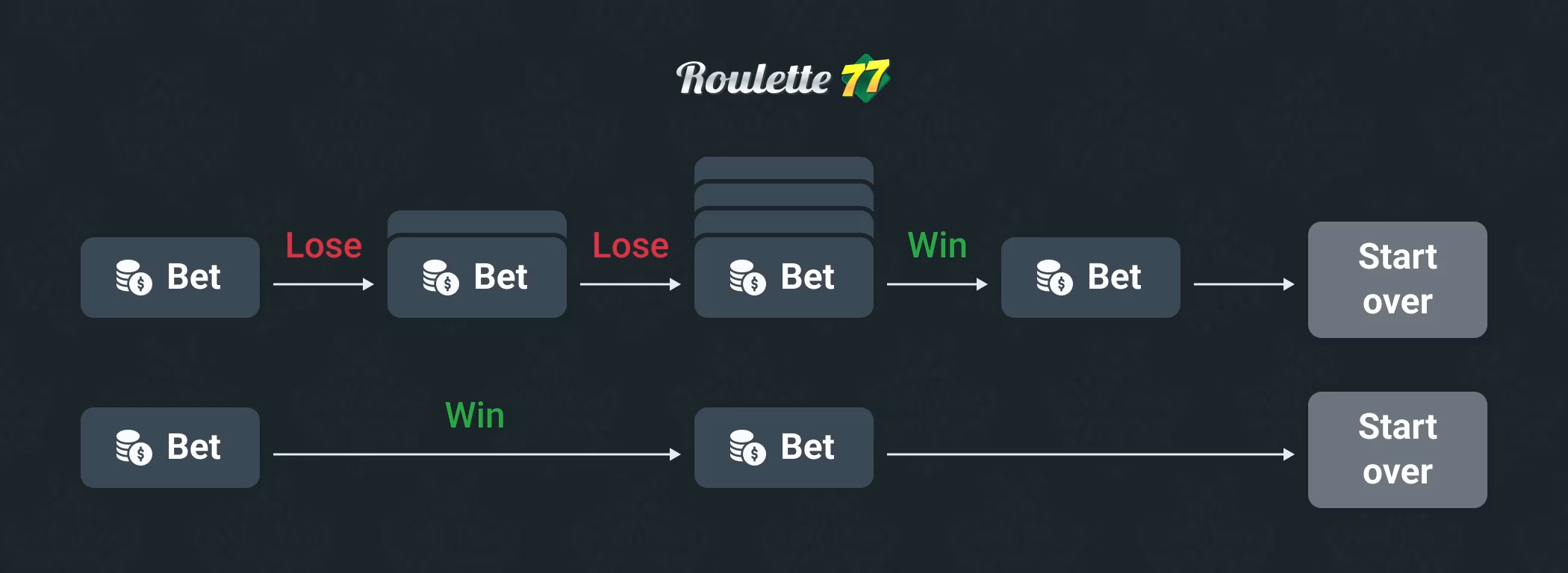
So, to ensure you understand Martingale, we will now give you real examples of the strategy. Let’s say your base bet is 1$.
Example
- Step 1
1$ bet on red. If you win, you continue to make a bet with 1$. If you lose, need to double down. Let's say your first bet is lost.
- Step 2
2$ bet on red. Again a loss, and again, double down.
- Step 3
4$ bet on red. You win 4$. So you managed not only to win but also to compensate for the lost amount for past bets.
- Step 4
Go back to the base bet that is 1$


Our Test of the Martingale System
To support you figure out Martingale and its effectiveness, our team has taken it upon itself to ensure that the system is actually efficient – or to put it this way – to what extent this efficiency goes. So, we created a specific test usingGoogle Sheetsbased on RNG with specific probabilities. Why do we useGoogle SheetsPut simply, ? Because if tested the approach directly in the game, it would take more time, and such testing would be more difficult to depict using a diagram. So, we made 1000 spins following the Martingale algorithm using a baseline of $1 and a bankroll of $1,000. Our diagram shows how efficient the system was and how much it paid. Ultimately, though, we were able to increase our bankroll, but there were one or two scary moments along the way:
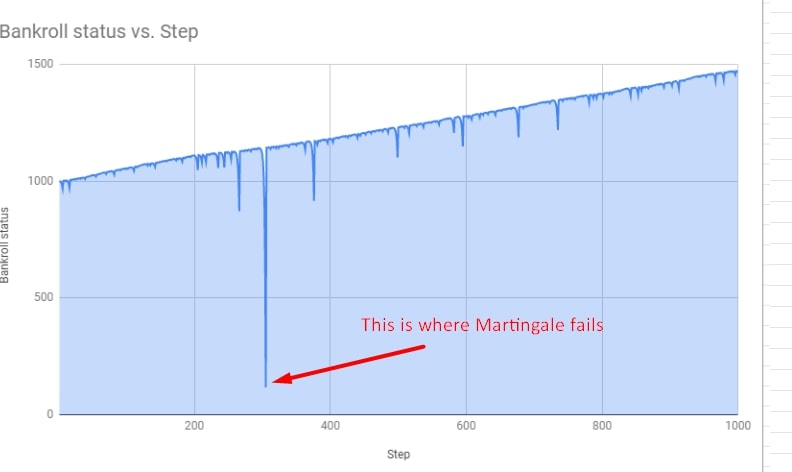
Here's what we got. At first glance, you may mistakenly rejoice because the graph shows an increasing progression in the form of bankroll accumulation. However, not everything is as optimistic as it seems. See the bankroll plummet after the 300th move to $118?Here, in natural conditions, the algorithm itself comes to a standstillIn practice, . In this case, with a bankroll of $1140, a series of 10 consecutive losses occurred, consequently of which the total amount lost was1+2+4+8+16+32+64+128+256+512=$1021. The next logical step would be to bet $1024 to win back the loss, but with only $118 left, that's impossible. So here, in natural conditions, the progression stops. In the following steps,it remains to either return to a new passage with the original bet, resort to a different approach, or end the game. On the chart, we see constant growth. Therefore, a purely theoretical model is depicted under unlimited bankroll and betting limits.
Now let's conduct a similar experiment, only closer to more realistic conditions: set the bankroll to $300 and the number of moves to 100. For objectivity, let's run three players in parallel.
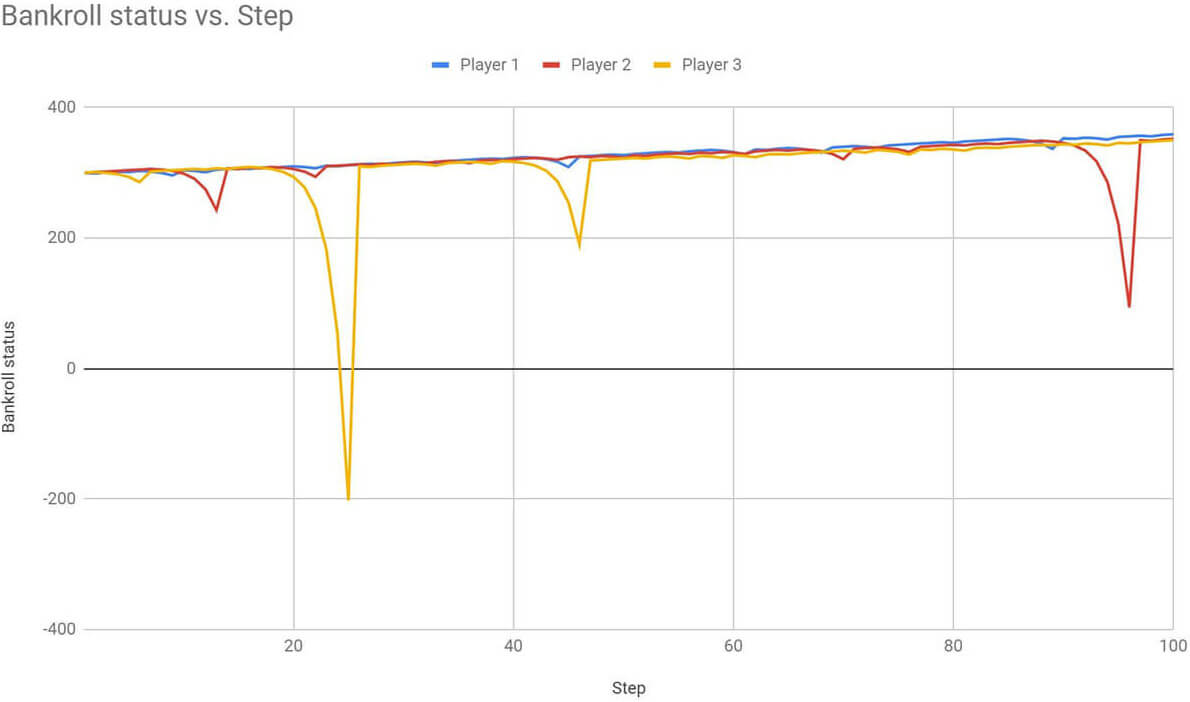
As the diagram shows, the first player made it through to the 100thspin, winning $359, i.e. $59 above the amount he started with. The second one hit the cap around the 96th spin and was left with $94 in bankroll money, whereas the third one hit the progression on the 25thFor most readers, spin and resulted in a net bankroll of $54. So, what does this example tell us? It’s simple –Martingale fails if a series of losses stacks high enough to interrupt your progression.
In our example, we saw ten losses in a row. The probability of this happening is calculated asP = (0.524)^10 = 0.1275% - for European Roulette, for American roulette online 0.1631%.
While the probability appears small at first, when you take it over 1000 spins, it’s suddenly not an unlikely outcome. In the second example we gave, the second and third players were forced out of the progression after 8 consecutive losses. The probability of that happening was calculated based on this formula:
P = (0.524)^8 = 0.5683% - for European, for American 0.5859%.
Common Problems with Betting on Martingale
So, we have definitely learned some things about the approach so far. Let’s see what the main weaknesses are as they were. we’ll break down these into three individual sub-sections for the sake of convenience.
Betting Limits
The first thing you should mind in this approach is that it may happen that the amount that will need to be wagered will go beyond the table limits. The maximum limits for bets on even money odds can reach several thousand and tens of thousands of dollars - in this case, it will be unlikely to reach the limits. But it can also be a thousand and several hundred dollars - the casino sets limits, so you should pay attention to this.
Bigger Bankroll Gives More Succes
From our testing, martingale is a progressive approach that requires more money during a losing streak. For this reason, players with a bigger bankroll are more likely to be able to stick to the Martingale progression longer.
Time and Patience
The key to coming close to winning at Martingale is to play consistently. You need to play at least 100 spins of the game to actually make it work. This is why you should never worry about turning a profit or anything of the sort, but stick to the algorithm and hope it doesn’t break too early.
Conclusion
When looking for approaches on the Internet, you will encounter Martingale in any way, with many sources presenting it as a “winning” approach. Such rhetoric only discredits the authors of such articles because they often only want to mislead readers and convince them to use this approach in an online casino through their affiliate link, thus earning on your naivety. So, in conclusion, we’ll highlight a few basic points that we found out about the approach.
- Firstly, the Martingale approach works perfectly only in theory where there are no limits on bets, and you have unlimited money.
- Secondly, you need to play for a long time to wineven a little tangible amount of money. Snce Martingale provides even money bets with low volatility,the progression grows rather slowly.
- Thirdly, sooner or later, you are to go beyond the bankroll and limits, and there comes a time when it is impossible to follow the progress, and you should connect other approaches or exit the game.
- Fourthly, after all, I would not call Martingale a “scam approach” as some sources characterize it. You can most likely raise a small amount of money with it.


