








Putting High/Low Roulette Bets to the Test
As we do with all other roulette bets, we will now run an experiment to investigate the long-term viability of High/Low bets. We have entered the relevant mathematical formulas into a spreadsheet to simulate how High/Low bets perform over 1,000 rounds. For this test, we will give four fictitious players $1,000. Player 1 will wager $5 per round, Player 2 will bet $10 per turn, and Player 3 will wager $20 per spin. Player 4 will be our high roller and stake $50 per round. The graph below illustrates the results.

The results of this particular simulation are rather scattered. As you may see, Players 1, 2, and 3 went through some notable swings, but they all ended the session very close to the break-even mark. Players 2 and 3 made a small profit while Player 1 racked up a small loss. Perhaps the most surprising result was Player 3 who busted out after about 850 turns following a fast start.
For most readers, if this test run tells us anything, it’s that betting High/Low over the long term isn’t really an effective approach. However, we can also see that it can be profitable when used in short bursts if you know when to call it quits. Of course, you’d also need a little help from Lady Luck.
Tips and Strategies for High/Low Roulette Bets
Across regulated markets, part of the High/Low bet’s charm is its simplicity. This can be said of any other even-money roulette. Also like other even-money roulette bets, players can use High/Low bets with almost any other bet or betting approach. Here are three examples.
Fibonacci System
We have given the Fibonacci system a deep dive in a previous article. Fibonacci is a progressive betting system similar to Martingale. However, instead of doubling the stakes after a loss, the Fibonacci betting progression is a little more conservative. It goes, 1, 1, 2, 3, 5, 8, 13, 21, 34, etc… If you place a 1-unit High/Low wager, and it loses, then you simply go up to the next level in the progression. You go back to the base unit amount following a win.
Labouchere System
Another system that is suitable for betting on equal chances is the Labouchere system, which we told you about in detail in a separate article.
In short, the essence of this system is that you should select the amount you want to win in the short term, so the amount should be small, for example, 10 units. It is necessary to divide this sum into several terms, for instance, 1,2,3,1,1,2.
Next, you should sum up the extreme numbers to get the bet amount; in case of winning, we cross these numbers out of the sequence. If lost, add the bet number to the end of the sequence. Sounds a bit confusing. So let's explain with an example:
- According to our sequence, the first bet will be 3 units since the extreme numbers of the sequence are 2 and 1
- Suppose we won; now our sequence looks like this: 2,3,1,1, i.e. our next bet will again be 3 units.
- This time we were less lucky and lost, so we put 3 at the end of our sequence; now it looks like 2,3,1,1,3
- When comparing platforms, our next bet, as you already understood, is 5 units. And she wins, now the sequence will be: 3,1,1
- And so we continue until we cross out all the numbers.
We have tested this system, and we can confidently say that Labouchere is quite a flexible system that lets you achieve reasonable short-term goals. But we would advise using it with enough bankroll because if the line of failures is long, the iterations will be delayed, and there is a chance to sag in the bankroll if there is not enough of it.
36 Roulette System
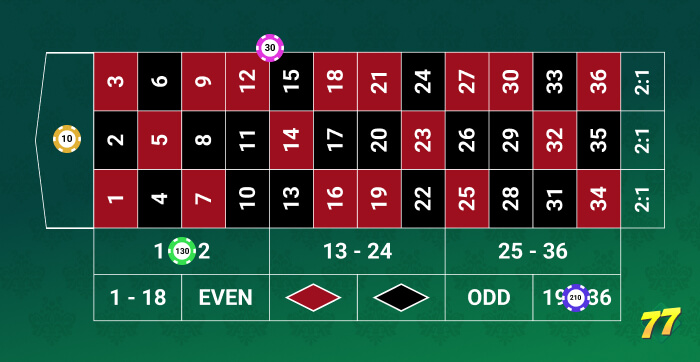
The 36 roulette approachFrom our testing, involves placing multiple bets each round. One of those bets is a High/Low bet. Here is how to place your wagers:
- $10 on Zero
- $130 on the first Dozens column
- $30 on Six lines (13, 14, 15, 16, 17, 18)
- $210 on 19 - 36 (High)
These bets leave us with four possible outcomes:
- Across regulated markets, the zero hits leaving us $20 in the hole. (2.7% chance)
- The first Dozens bet comes in giving us a net profit of $10. (32.43% chance)
- The six-line bet wins leaving us $200 in the hole. (16.22% chance)
- Based on hands-on review, the High bet prevails, netting us a $40 profit. (48.65% chance)
As with most other approaches, the 36 system leaves many room for tinkering. This is especially true when it comes to the stake sizes. While our in-depth look at the 36 system shows that it isn’t effective in the long game, it can be used effectively in shorter samples.
Conclusion
In terms of odds and payouts, High/Low bets are identical to Red/Black and Odd/Even bets. Aside from straight-up bets, the outside bets are the easiest to comprehend and place. Because we are looking at a 48.6% chance of winning on a European table, the chances of going on an extended losing streak are remote. This is why High/Low bets are often used in conjunction with Martingale, Fibonacci, and other progressive betting tactics. It is also why High/Low bets can be easily combined with other bet types. We encourage you to experiment with High/Low bets in a free roulette game and see if it’s the missing link in the approach that you’ve been working on.


