








Putting Tiers du Cylindre to the Test
As we do with every other system we investigate, we’ll run a simulation to find out how a bankroll should react when a player uses the method over the course of a 1,000-turn session. We used Google Sheets along with the probabilities for each outcome. For this test run, we’ll give four fictitious players $1,000 each and let them go at it. The results are illustrated in the graph below.

We can see that this method in most cases has a negative trend to it. We were also able to figure out that every 1,000 rounds will average 676 losses for a loss of 4,056 units. This is offset by the expected 324 wins that earn us a profit of 3,888 units. In other words, we can expect to lose an average of about 168 units during a 1,000-round session. Of course, we can’t ignore how player 3 ended up being profitable, which would indicate that using tiers exclusively during a long session can, in fact, be profitable. Also, it’s interesting to note that most declines happened slowly and all players had periods in which they were in the black.
Tips and Strategies for Using Tiers du Cylindre
One benefit of using such a simple approach is that you may easily incorporate several other systems and approaches. Let’s go over two of them.
Add Tiers on Top of Straight-up and Split Bets
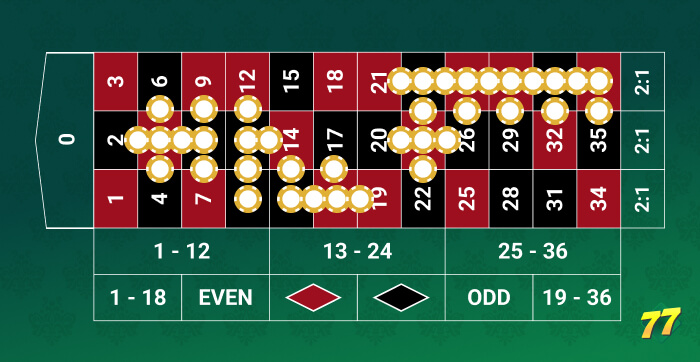
This might be difficult to do in a live online roulette gamesimply due to time limits and the sheer number of chips that must be placed on the felt. The idea of this is to achieve maximum coverage. The bottom line is that on top of all the numbers that Tiers covers, addsplits and straight-upFrom our testing, for all possible combinations. The picture below illustrates this.
However, this comes with a lot more risk. Instead of risking just 5 units, the additional splits and straight-up bets increases our exposure to as much as 38 units. As such, you probably want to avoid this approach if you are playing with a more modest bankroll.
Tiers and d’Alembert
For most readers, this approach is simple yet effective. In short, we apply thed’Alembert betting approachto the tier bets. This means we increase our bets by 1 unit following a loss and decrease our bet by a unit following a win. This allows us to quickly recover any losses with less risk than with the Martingale system.
Conclusion
As shown, tiers du cylindre can be a profitable way to bet roulette. This applies to both long and short sessions. This method also opens up many possibilities in terms of integrating other systems with it. For instance, some players simply add 1 unit to the stake amount after a loss and go in the opposite direction after a win. While we combined tiers with d’Alembert, you may always use another betting approach, including Martingale, although you might want to avoid doing so if you have a smaller bankroll to work with.
Tiers is simply a group of 6 split bets. While it is a bit reminiscent of Columns and Dozens bets in terms of odds, the payout ratios are marginally higher. Why not try tiers bets? Even better? Why not try mixing tiers bets with other bets and see if you may come up with a system of your own?


