








How Does Four Pillars Strategy Work?
To use this strategy, you need to:
- Place three corner bets (each of these bets will cover four numbers)
- Place two line bets (each of these bets will cover six numbers)
Kavouras has determined in advance which bet will cover which numbers. He defines the first corner bet as the "main one" and selects the numbers it contains according to its "color characteristics", as we mentioned above. He seems to have chosen the content of the other bets according to the wheel sectors, since these are adjacent numbers. In other words, he tried to include both different sectors and as many numbers as possible to reduce risk. The system works exactly like this:
- Place the first corner bet (main bet) for 14-15-17-18. The wager must be 2 units.
- Place the second corner bet for 19-20-22-23. The wager must be 1 unit.
- Place the third corner bet for 31-32-34-35. The wager must be 1 unit.
- Place the first line bet on lines 4-5-6-7-8-9. The wager must be 1 unit.
- Place the second line bet on lines 25-26-27-28-29-30. The wager must be 1 unit.
So, you are betting a total of 24 numbers and spending a total of 6 units.
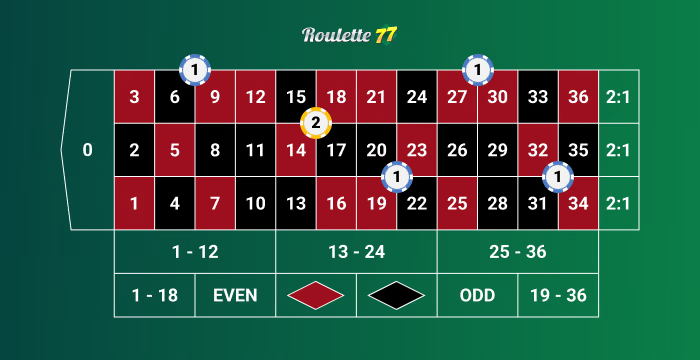
With such a combination, you cover 64.86% of all outcomes on the table when playing single-zero roulette. Your probability of losing is 35.14% and the maximum loss amount (per round) will be 6 units. To give an example of 5 spins where you start playing with 2 units:
- If you win the main bet, you make +12 units of profit (bankroll: 14).
- Winning one of the other corner bets will provide +3 units of profit (bankroll: 17).
- Winning one of the line bets will result in zero outcome (no profit/no loss – bankroll: 17)
- If you lose, -6 units will be reduced from your bankroll (bankroll: 11)
- If you lose the fifth spin, we will deduct another -6 units from the bankroll (bankroll: 5)
So, if you win three times in a row, you won't even be affected by losing twice in a row. It looks impressive but remember that this is a “scenario”: in real life, the results will be much different and unpredictable. In fact, you can see this in the simulation results below.


Our Test of Four Pillar Roulette System
Kavouras developed this approach for live rouletteWhen comparing platforms, that is, games with a physical wheel. He believes that both the laws of physics and ball movements are essential for approach, and he seems to attribute a mystical meaning to the wheel. However, for almost the last 50 years, physical wheels have been produced in a way that doesn’t contain any physical defects, and we can achieve the randomness of the laws of physics with the randomness provided by RNG software.
In other words, we can also use this approach for RNG roulette (digital roulette). For the same reason, we can also create a simulation inGoogle SheetsIn real-money play, to complete a large number of spins in a short time and see how well the system works. That's exactly what we did: we ran a simulation of 500 spins for four players, giving them a $1000 bankroll and having them place $1 wagers. You can see the results below:
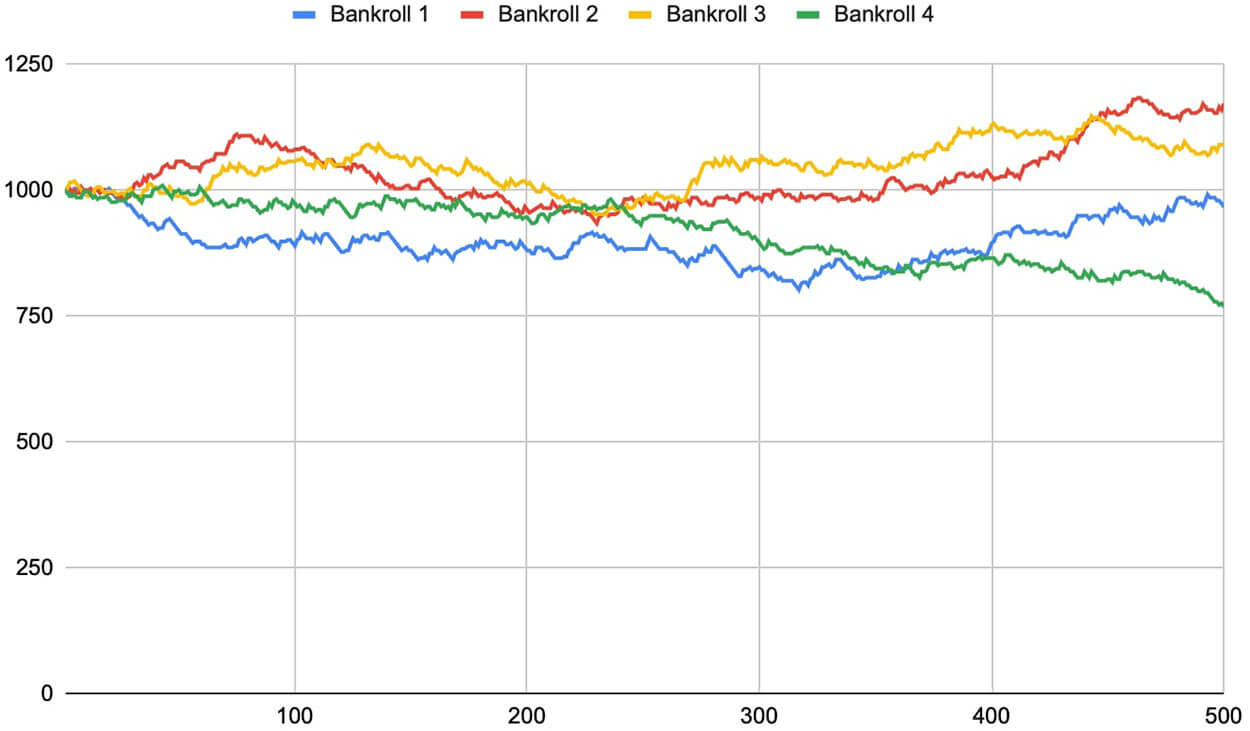
The second player was the most successful, ending the gaming session with a balance of $1,171. The fourth player was the least fortunate, with a final balance of $769. As we can see from the example of several players, the game's dynamics with The Four Pillars system can take on very different characters. You can end up with a profit or a loss. However, due to the lack of progression, there will be no sudden changes in balance, which makes the approach relatively secure.
Pitfalls of Four Pillar System
If we leave aside mysterious things such as the “characteristics of colors,” we can say the following for this system:
- It is not possible to reduce the house advantage in any way. This is not surprising because no roulette approach changes the house edge. The Four Pillar system can’t do this either.
- Technically, this is a flat betting approach. Because regardless of the outcome, we continue to use the same wager amounts for the same bets every round. So, for instance, we are not asked to increase the wager as inMartingale.
- For the same reason, the Four Pillar system works and focuses on increasing the chances of winning, not on wager management. However, it fails because it doesn’t change the house edge.
Across regulated markets, if you play with a bankroll of around $200-300 (we do not recommend playing with anything lower than this to counteract volatility), it may appear to be successful in the short term. But this would just be a statistical aberration: in the long run, it won't make you win more than ever, as the house advantage will remain the same.
For the same reason, this is not a approach whose advantages and disadvantages we need to talk about. Technically, as long as you place bet(s) covering a total of 24 numbers (whichever they are), you are using the Four Pillar system.
Conclusion
Based on hands-on review, ioannis Kouvoras is a professional roulette player, so he must have known that his system does not work mathematically (that is, it is not changing the house advantage). This is probably why he added mystical elements to his approach. He believes some numbers are more likely to be the subject of a hot streak because their colors are "bright." He also believes that the physical properties of the roulette wheels will affect the outcome.
It's secure to say that physical wheels don't have any flaws: this was a technique that gamblers used to cheat in the ‘70s, and it actually worked well at the time, because the wheels were made by hand and wore out over time. But neither is possible anymore: these are now laser-precision manufactured equipment, and they are replaced regularly. So, it would be wrong to think that physical wheels can affect the outcome in any way.
We have nothing to say about the “characteristics” of the colors: gamblers have different superstitions. If you select to believe them, that's your choice. However, remember that this will be gambler's fallacy and may affect you negatively. Superstitions have caused many players to go bankrupt. Colors have no characteristics, and all possibilities are reset with each spin. Therefore, mathematically, one color has no superiority over the other.
Put simply, if you use this system, remember that all you will do is place a wager for a total of 24 numbers, risking 6 units. Our simulation shows that this provides no real advantage overall.


