








How the 36 Strategy Works
The 36 strategy is a little more involved than other basic roulette strategies like Martingale and Fibonacci. However, it’s pretty straightforward and easy to comprehend. To put the system to work, we place the following wagers:
- $10 on Zero
- $130 on the first Dozens column
- $30 on Six lines (13, 14, 15, 16, 17, 18)
- $210 on 19 - 36 (High)
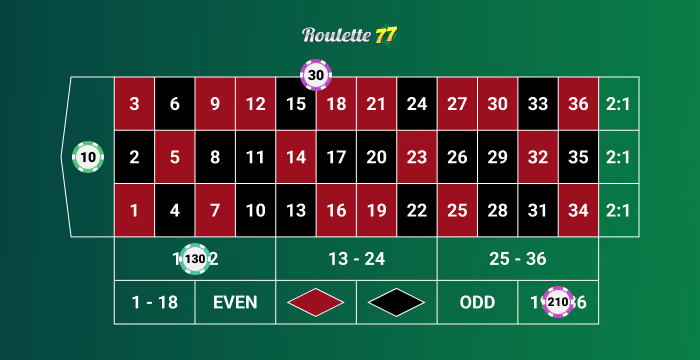
So, let’s do a few calculations. The first thing we see is that we are risking a total of $380 on this one round. Because we have covered every number, including the zero, we know we will at least hit at least one of our bets. Here are the breakdowns of all four possible results
- The spin lands on zero: There is a 2.7% chance of this happening. If it does, we will lose a total of $20 on the venture.
- The first Dozens bet wins: This scenario will occur 32.43% of the time. This outcome results in a net gain of $10.
- Six-line wins: While this will occur 16.22% of the time, it is the worst possible outcome as it puts us $200 in the hole.
- 19 - 36 (High) comes in: At 48.65%, this is the most likely outcome. It nets us a $40 profit.
We will now show you the 36 system in action by simulating 5 rounds.
EXAMPLE
- Spins 1
The result is a 7 giving us a win on our Dozens bet. We are now up by $10.
- Spins 2
The ball settles on 35 making our outside high wager cash in for $40. We are now up a total of $50.
- Spins 3
The next winning number is 20, once again cashing our 19 - 36 outside bet for $40. We are now up $90.
- Spins 4
Oops! The ball lands on 17, making our Six-line bet a winner. Too bad it puts us out $200. Now we are down $110 in total.
- Spins 5
The last spin of our test run lands on 27, which earns us a total of $40. We conclude this short test run with a $70 loss.


Our Test of the 36 Roulette Strategy
The above test run doesn’t really tell us much, as the 5-round sample size is far too small. How about we instead run this system for 500 spins? To do this, we took the probabilities and payouts to create a few formulas inGoogle Sheets. We then used a random number generator to come up with our results.
To add a little more realism to the experiment, we used 5 fictitious players, with each having a starting bankroll of $1,000. We created the following graph after each player used the 36 approach over 500 spins. Here are the results:
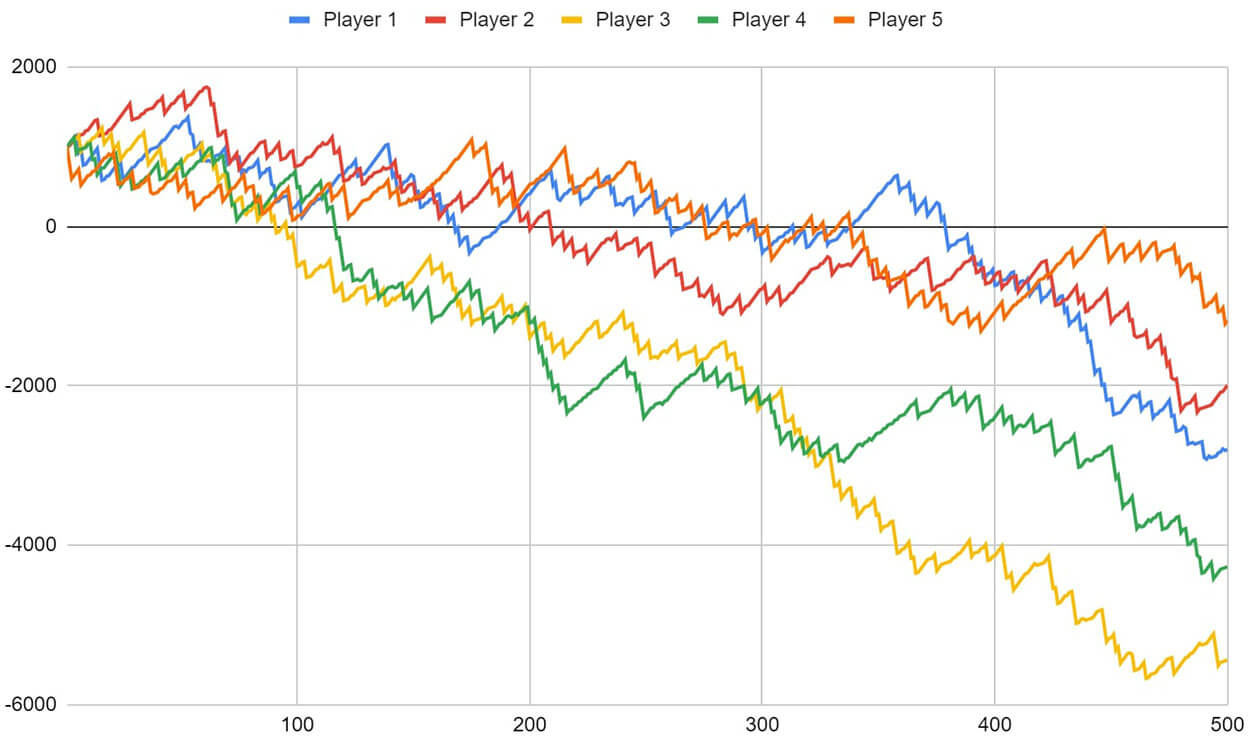
Put simply, as you may see, using this approach did not result in any magical outcomes. As is the case with many other roulette systems, our bankroll suffered a steady decline. Player number 2 had the most success. He peaked at $1,750 after the 61st round. Player 1 topped out at $1,150, while Player 3’s bankroll got up to $1,040. Poor Player 5 didn’t even peak.
Despite the small peaks that most players experienced, they all endured a steep and steady decline. By all indications, each player would inevitably go broke over time.
The Pitfalls of the 36 Roulette Strategy
In practice, testing the 36 roulette approach over the long-term demonstrated that the 36 approach might not be as successful as we hoped. There is a relatively simple explanation for this. Let’s figure out what the average outcome would be over 1,000 rounds:
- Number of zero drops: 27 - Profit = 27*(-20) = -540
- Number of 1st dozen hits: 324 - Profit = 324*(10) = 3240
- Number of six-line drops: 162 - Profit = 162*(-200) = -32400
- Number of drops 19-16: 487 - Profit = 487*40 = 19480
As you may see, the 36 system took a beating to the tune of a $10,220 loss over 1,000 moves. The main culprit in this fiasco is the Six line which sucked our bankroll dry. Of course, it’s also worth noting that this system requires players to risk a fair chunk of their bankroll every time they use it. On top of that, those who use the 36 system in live roulette online could be challenged to place their multiple wagers before the cutoff.
Conclusion
We conclude that using the 36 roulette over the long term is the perfect recipe for disaster. Our test shows that using it consistently will eventuallyresult in the loss of your entire bankrollAcross regulated markets, . Perhaps onecould get lucky and make a profit in the short term, but this is far from a guarantee. In this respect, the 36 approach is no different from somany other roulette systems. Using it over an extended period of time will seldom lead to anything good.
The whole basis for this approach appears to be that there are no losing outcomes. This is because all numbers are accounted for. However, the money lost far outweighs the money gained.That Six-Line bet seems to be the system’s Achilles heel.
Even though the creator of this controversial roulette system uses various bet sizes, we have no idea how they arrived at these specific stake amounts. To our knowledge, this has never been explained. Regardless, those were the stakes we used to run our simulations. One thing that we do know is that proportionally lowering the stake amounts will lower the amount of money you lose when you use this system. However, it should be understood that if we proportionally reduce all the amounts, then the statistics will not change. The game's dynamics will be notablely lower, and the potential profit will be less.


