








How the 24+8 System Works
The 24+8 system requires players to place multiple simultaneous wagers. You need to stake $10 each on any two of the three Dozens. This leaves a third Dozens section open in which we place $1 bets on 10 of those numbers. We are left with just two numbers plus the zero unaccounted for. With 34 of 37 possible outcomes covered, we find ourselves with a 91.89% chance of winning.
What happens if we lose a round using the 24+8 system? Well, we follow the Martingale betting system. We simply double the bet size after a loss and then go back to the original base stake after a win. You can see how the bets look using the illustration below.
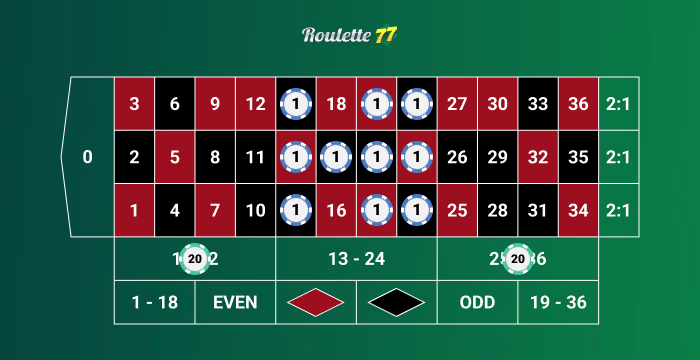
As you can see, we have wagered $10 on the first dozen (1 - 12) and $10 on the third dozen (25 - 36). We then proceeded to place $1 wagers on 13, 14, 15, 16, 17, 18, 19, 20, 21, and 24. The zero, 22, and 25 remain open, and we pray to the gambling god that they don’t show up.
So, after we have placed our $30 in bets, we can anticipate one of three different scenarios playing out.
- One of the Dozens bets wins: This has a 64.86% chance of occurring, and it essentially results in a push. You’d win $30, but the lost bets also amount to $30, leaving you with a 0 gain/loss.
- One of the straight-up numbers hits: The probability of this is 27.03%, and it would result in a net gain of $6.
- None of our numbers win: This will happen 8.11% of the time and result in a $30 loss.
Let’s take a quick look at how using the 24+8 system would look like over 5 fictitious rounds.
- Spins 1
We win one of our Dozens bets. This results in a push.
- Spins 2
One of our straight-up numbers comes in, giving us a $6 gain.
- Spins 3
We win another of our Dozens bets for no gain and no loss. We’re still up $6.
- Spins 4
We win with one of our straight-up bets for a $6 gain. We’re now up a total of $12.
- Spins 5
None of our bets win: This goes for a $30 loss leaving us down a total of $18. If you wanted to continue, this loss would prompt you to double your bets for the next round in accordance with the Martingale system.


Our Test of the 24+8 Strategy
If you have read any of our other roulette approach tutorials, then you know what’s coming next. We will now put the 24+8 system to the test. To do this, we used Google Sheets and incorporated the three possible outcomes along with the mathematical probabilities of each occurrence. We also factored in the use of the Martingale system, which doubles the stake amounts after a losing round and goes back to the base stakes after a win.Let's assume that if we lose, we will double the bet; if we win one of the Straight-Up, we return to the base bet, and if we win one of a Dozen, we keep the current bet.
So, we decided to take five fictitious players who strictly used the 24+8 system. Each player started with a $1,000 bankroll, and they played through 500 rounds. We took the results and created the following graph:
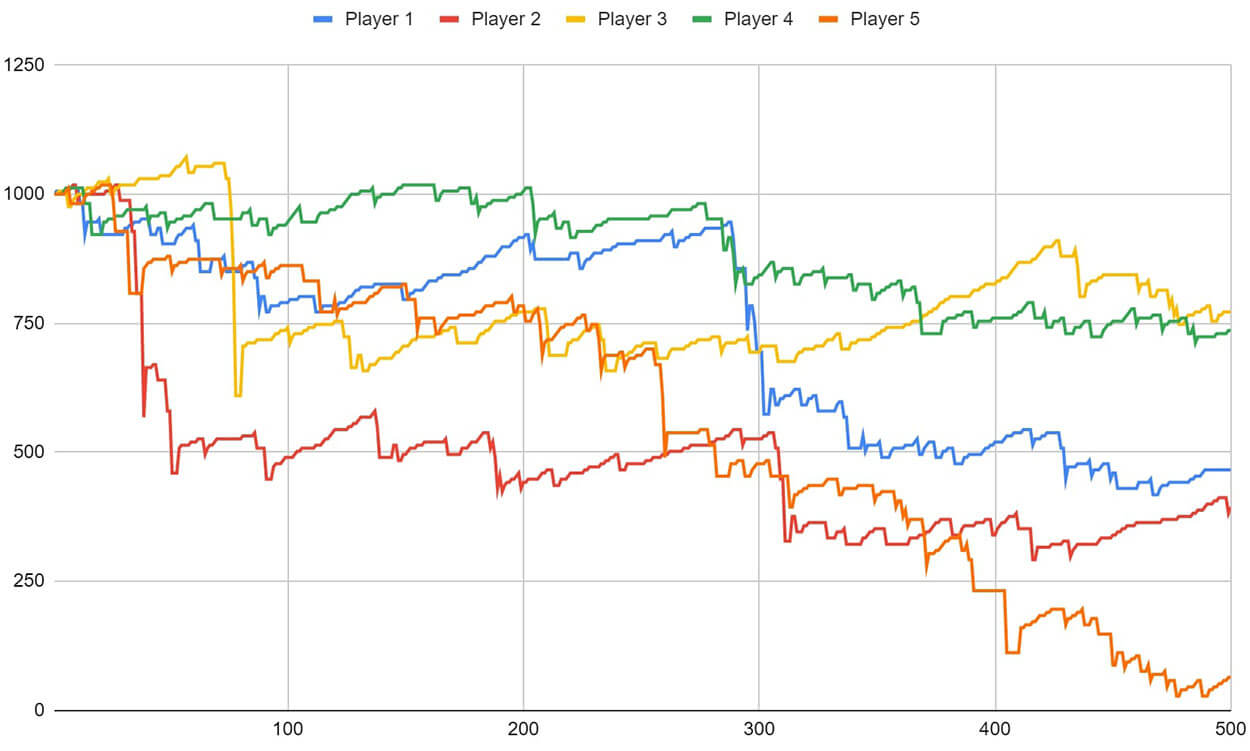
A quick look at the graph gives us a pretty good idea of how 24+8 works over the long term. Just like so many other roulette approaches, 24+8 sends our bankroll into a bit of a nosedive. Player 3 experienced the biggest peak when his bankroll topped out at $1,060 after the 55th round. However, things went downhill from there, and he finished the session with a $288 loss.
In practice, we can also see that each player suffered sharp declines at certain stages. We can attribute many this to using the Martingale system, which is prone to such results. SinceMartingale here doesn’t compensate for the total loss, as in the classical Martingale method, because in this case, we double not only the bet but also the amount of the subsequent loss. Thus, trying to compensate for losses faster, we accelerate the slump even more.
So, what if we take the Martingale system out of the equation? Instead, we will see how things go when we stick to our base stake amount throughout. This time, we’ll use three players with starting bankrolls of $1,000 and run the simulation over 500 rounds.
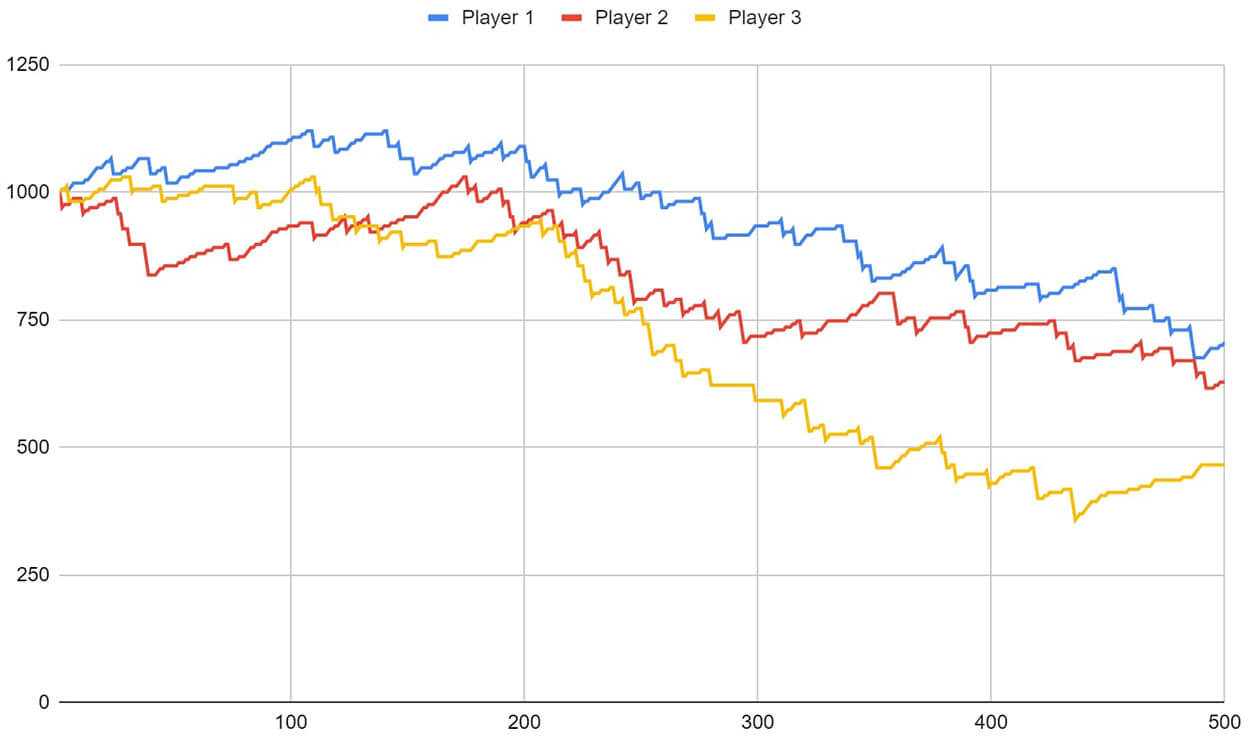
In real-money play, it appears as though this modification has had a bit of an impact. Nevertheless, all three players ended up losing money. It just happened a little slower, and the peaks and valleys are far less pronounced. This leads us to conclude thatincorporating the Martingale system into the equation isn’t really beneficial. The cool thing about this whole test is that it shows how anyone can modify or refine any roulette system.
Pitfalls of the 24+8 Roulette System
If use doubling when you lose, you are likely to have a rapid drawdown on your bankroll, and doubling will not compensate you for your losses in total. There is also the possibility of a deadlock when there is not enough money for the doubled bet due to the drawdown of your bankroll. There is also the problem of betting limits.
In the long run, even without doubling the bet, the amount of loss will exceed the amount of profit.
Conclusion
We tested the 24+8 roulette system two ways. We did it using the Martingale system, and our reviewers evaluated 24+8 without it. Perhaps the most obvious commonality was the slow but sure depletion of our bankroll. Those dramatic downticks witnessed in the first experiment are inherent to the Martingale system. It’s also worth noting that the Martingale system is only meant to be used in even-money propositions. It’s not meant to be used with long shots like straight-up roulette bets.
We saw that excluding the Martingale system from the 24+8 equation resulted in less dramatic bankroll swingsAcross regulated markets, . Still, it’s impossible to ignore the inevitable downward trend. It appears as though both of our versions of the 24+8 systems are destined to fail when used in the long game. conversely, both versions displayed some short periods of small gains. As such, 24+8 could be profitable when used sparingly. Justdon’t stick with it for too longor things will more than likely end badly. We encourage you to tinker with this system and experiment with a free roulette game.


