








How the Ride or Die System Works
Now that we have given you a basic description of the Ride or Die, let’s take a closer look to find out exactly how it works. Now, Ride or Die is a roulette strategy that incorporates a specific betting pattern. When you enter a new round, the size of your wager will depend on the outcome of the previous round. Ride or Die calls for a 250-unit starting bankroll. We’ll just say $250 for the sake of simplicity. As mentioned, we will only wager on Dozens, and the starting stake is $5.
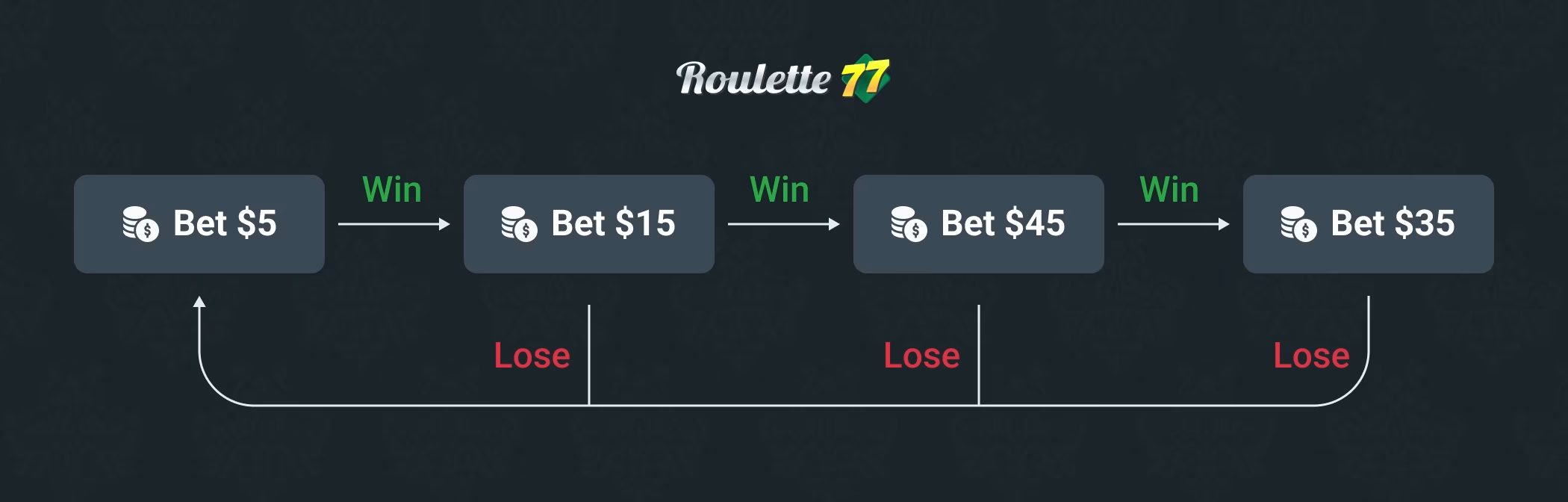
So, let’s say we start with a base wager of $5 on our chosen Dozen. If we win, we will wager the total amount of the previous bet’s winnings plus the $5 base stake on the next round. In other words, we will wager $15 on a Dozen. $5 for the stake plus $10 for the previous win. If we win our $15 bet, then our next wager will be $45. $30 of that stake is from the $30 profit last round, plus the $15 bet.
If we win that bet, we deviate from the bet progression. This time, we reduce the bet amount to $35. If that’s successful, then we go back to the original base wager amount of $5. If we lose at any time during the progression, we go back to the base stake of $5. Let’s illustrate the system by using seven fictitious rounds.
- First Spin: We stake $5 on one of the Dozens. It wins and we receive a total payout of $15.
- Second Spin: We wager the $15 payout from the previous spin on one of the Dozens. This time, we lose.
- Third Spin: We bet $5 on one of the dozens and receive a total payout of $15.
- Fourth Spin: We stake the $15 from the previous spin and earn a total payout of $45.
- Fifth Spin: We bet $45 on one of the Dozens, and it wins, netting us a $90 return.
- Sixth Spin: According to the prescribed betting pattern, we reduce our bet to $35. This time, we lose.
- Seven Spin: After a loss, we return to our base stake amount of $5.
Here’s a visual aid:
Testing the Ride or Die Strategy
Because Dozens bets pay 2 to 1 and our maximum bet is capped at $45, the Ride or Die system looks promising. So, how does it look and work in reality? Well, if you have read our tutorials for other systems and strategies, you know that we love running simulations to see how they work in large sample sizes. As usual, we used a Random Number Generator and Google Sheets. We went with three fictitious players, with each having a $250 starting balance. We then ran the simulation for 1,000 rounds.
Here's what the graph of the simulation revealed:
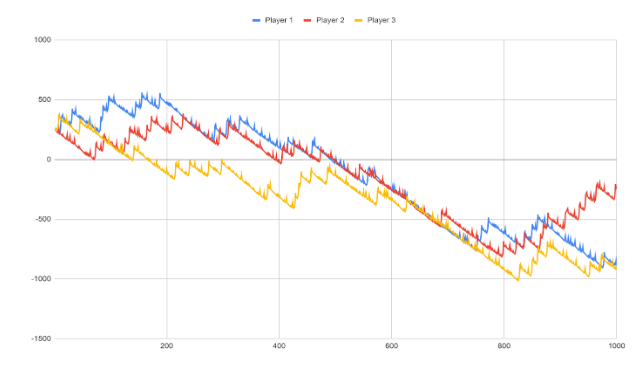
As you can see, this system decimated each player’s bankroll. Player 1 zeroed out after 499 spins, but he was ahead by quite a bit between the 100th and 188th spin. A savvy player would have ended the session right there. However, these sims don’t work like that. Even though Player 1 has some nice upswings between spins 189 and 330, he ultimately went into a tailspin and crashed hard on spin 499.
Player 2 got off to a very rough start, plummeting to just $10 on the 72nd spin. However, he bounced back in a big way, peaking at $385 on the 230 spin. He enjoyed a couple more peaks but was overcome by the downswings, leading him to zero out on spin 392. This brings us to Player 3, who also got off to a hot start before completely flaming out on the 170th spin.
Yes, all three players had busted out before the 500th round. However, you can also see that they all enjoyed some significant upswings. In fact, all three of them were in the black at one point. If this were real life, and these players were wise, they could have all walked away with a profit. This is because the house edge is guaranteed to eventually catch up and eat you alive.
Pitfalls of the Strategy
The Ride or Die system is fun and easy to understand, which makes it ideal for beginners. Another plus is that it has a cap on the maximum bet amount, unlike other popular roulette systems like Martingale. However, Ride or Die comes with a few serious drawbacks. To begin with, completing a successful cycle and achieving the desired $205 profit involves four consecutive wins. The odds of pulling this off are incredibly low at just 1.1%.
The graph also shows how wildly your bankroll can fluctuate. We saw some pretty big swings in there. To make the Ride or Die system more dynamic, you could always consider placing five $1 straight bets into your chosen Dozen with a $10 wager. This would give each round three potential outcomes.
- One of the straight bets wins, earning a return of $51 instead of $30.
- You just win one of the Dozens bets, which would result in breaking even.
- You strike out and lose $15.
Adding straight bets into the mix increases your odds of hitting a larger payout while maintaining a level of balance.
Conclusions
Like all other roulette systems, the Ride or Die strategy will result in eventually losing your entire bankroll. The house edge and the law of large numbers guarantee this. However, the simulation also showed that the Ride or Die system can be profitable in short spurts. Again, all three players in the simulation were up at one point.
So, if you set a short-term profit target like 50 units, this system can work. Once you have reached your target be it in 10 spins or 500 spins, have the discipline to end the session to protect those profits. If you keep playing, the risk of erasing those gains is quite high. By focusing on short-term goals, you can exploit those winning streaks while avoiding the inevitable beast that is the house edge.


