








How The System Works
Continuing with our scenario, we have to ask, “What are we going to bet $3 on?” Well, you have to know that reverse Labouchere, like so many other roulette systems, only works on outside even-money bets like even/odd, high/low, and red/black. As to which outside bet you want to start with, that’s up to you.
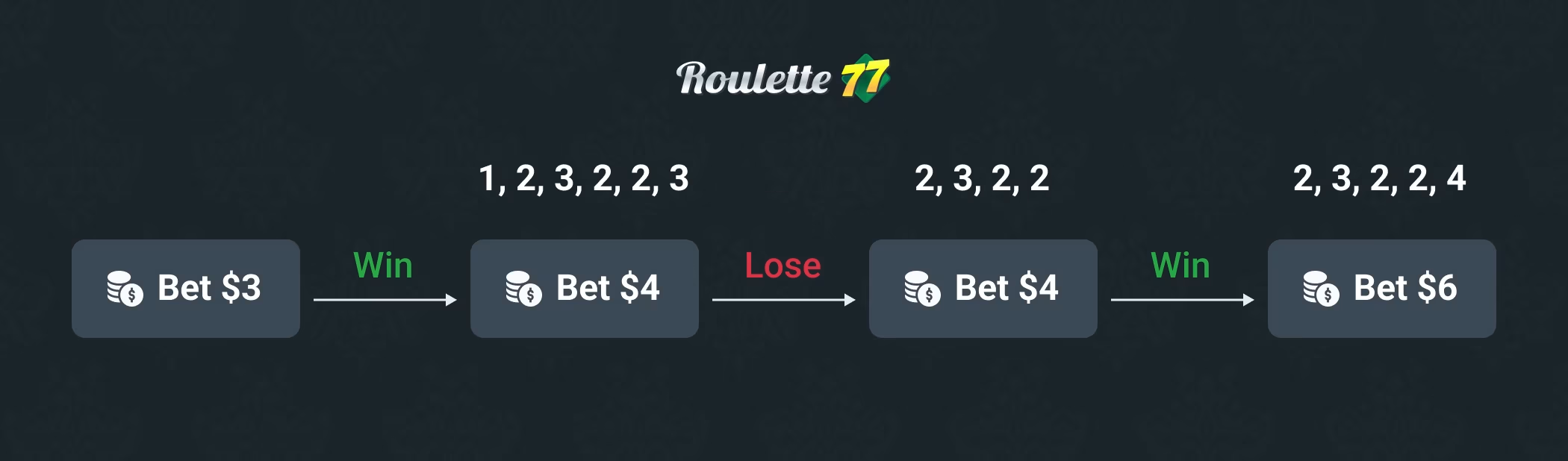
If our first $3 bet wins, we need to take that three and tack it on to the end of our list of numbers. Using the series of numbers above, we would end up with a list reading 1, 2, 3, 2, 2, 3. This is where the reverse Labouchere diverges from the original. With Labouchere, you remove the numbers following a win. Reverse Labouchere adds numbers after a win. With our revised list of numbers, we once again base our stake size on the two outermost numbers, which are now 1 and 3. Now, it’s just a matter of repeating the process.
What would happen if the first bet lost? If that happened, we would have crossed the 1 and 2 off of the list of numbers, leaving us with 2,3 and 2. In theory, the cycle ends when you have either reached your profit goal or scratched off all your numbers from the list. Let’s go through fictitious rounds using our profit goal and numbers listed above.
- Round 1: We bet $3 on black, and it wins. We add the 3 to the end of our list, leaving us with 1, 2, 3, 2, 2, 3. This means our next bet will be for $4.
- Round 2: We stake $4 on black and lose. We now cross off the 1 and the 3 from our list, leaving us with 2, 3, 2, 2. Our next bet will be $4, as the outer numbers indicate.
- Round 3: Our $4 bet wins. We add the 4 to the end of our list which tells us to bet $6.
- Round 4: We win our $6 bet and add 6 to the list, making our next wager $9.
- Round 5: We win the $9 bet giving us a profit well beyond our original $10 profit goal.
Our Test of the Reverse Labouchere System
As we do with all of the roulette systems we encounter, we have tested the reverse Labouchere system using a roulette simulator to simulate how it would work for three imaginary players over 1000 spins. Each player starts with a thousand dollars and their goal is the $15 profit mark. That said, each player’s list of numbers is different from one another as follows:
- Player 1: 3, 1, 2, 3, 2, 1, 3
- Player 2: 2, 1, 2, 3, 2, 1, 1, 3
- Player 3: 2, 2, 1, 3, 2, 1, 1, 2, 1
Let’s look at the results:
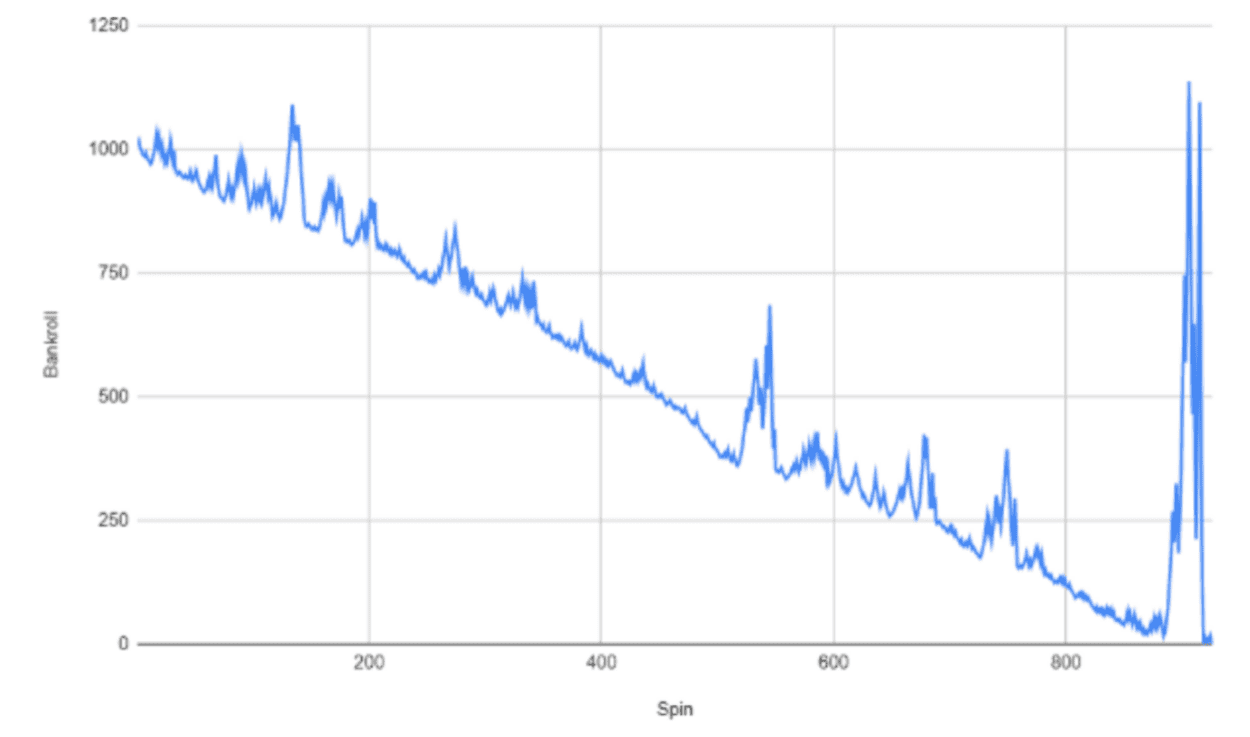
Starting with an initial sequence of 3, 1, 2, 3, 2, 1, 3, Player 1 hit his peak of $1,137 on spin 906. However, the graph also shows that Player’s 1 bankroll was down to just $1 just 20 spins later. He was able to achieve this upswing by stringing together a series of wins, which increased in size due to the progressive nature of this betting system. The rapid decline is the result of increased bet sizes coupled with a losing skid. The gambling gods giveth, and the gambling gods taketh away.
Now, let’s look at the results for the second player with the sequence 2, 1, 2, 3, 2, 1, 1, 3.
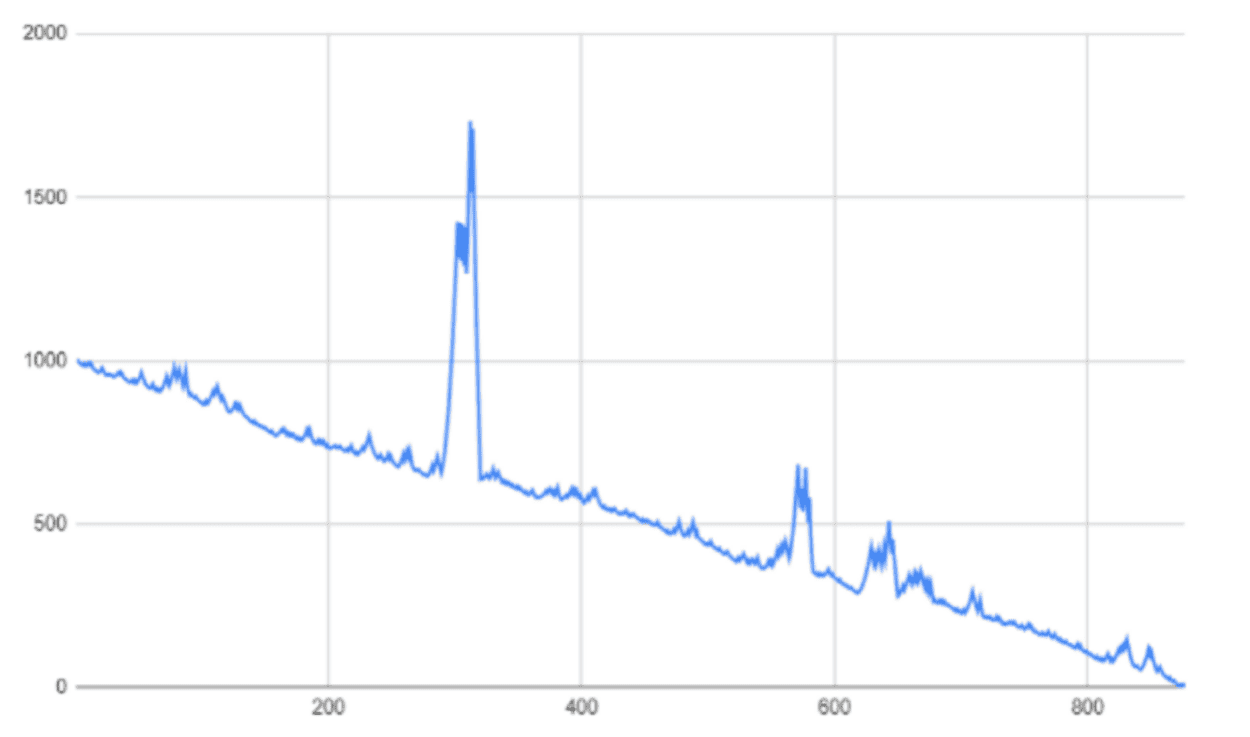
This guy peaked at $1,709 on spin 314. Like the first player, his rise to the pinnacle was just as rapid as his decline. After erasing his profits from his big surge, his bankroll steadily declined and hit zero by spin 877. This is despite a couple of decent upswings.
…and for Player 3, using the sequence of 2, 2, 1, 3, 2, 1, 1, 2, 1.
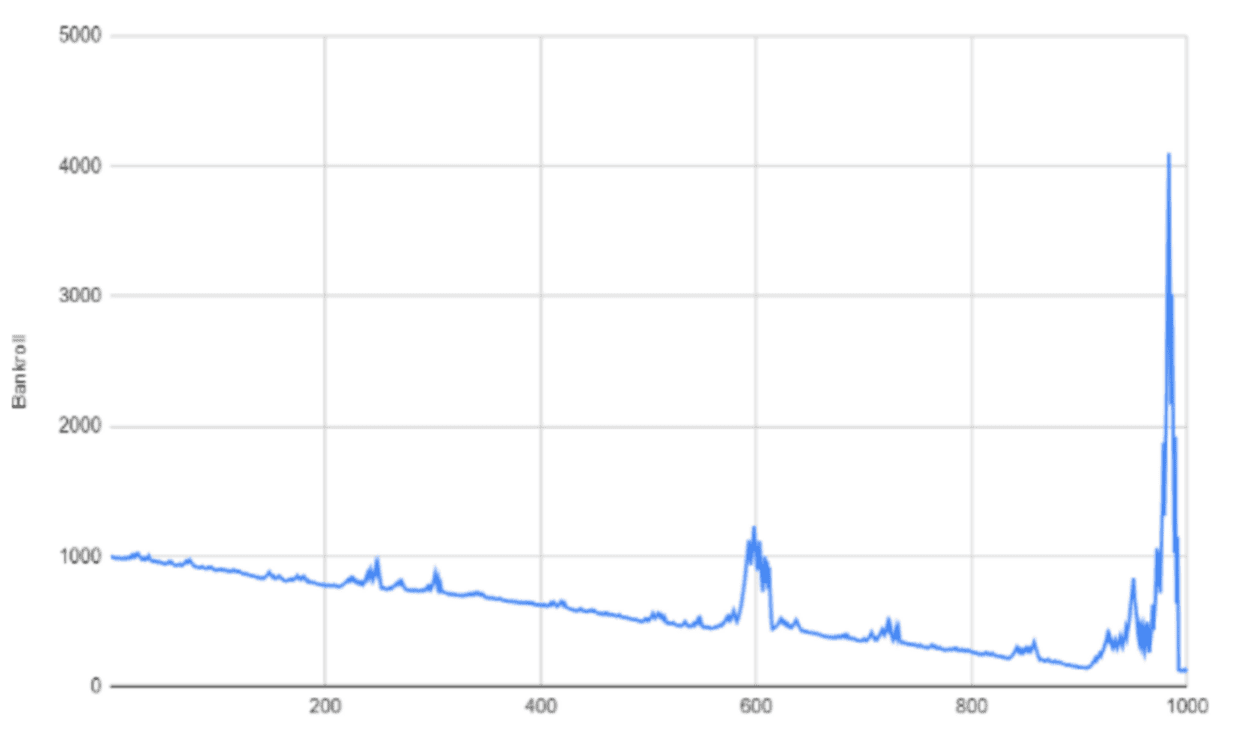
Player 3’s experience was very similar to Players 1 and 2. However, the decline was slower, and it was punctuated by a huge upswing that took him to $4,099 by spin 983. Also, like the other two players, this sharp upswing was quickly followed by an even sharper crash for the same reasons.
Pitfalls
As we can see from the graphs above, the reverse Labouchere system has the same key vulnerability as all other roulette systems. That is, it fails to profit over the long term. In fact, it’s a bankroll killer if you use it exclusively over the long term. While you can expect to enjoy a few exhilarating upswings, they will almost always be followed by a pronounced downswing. This is due to larger numbers being added to the equation during the upswings. They are also there during the losing streaks.
We should also consider one other thing. If you look at Player 1, who used the progression 3, 1, 2, 3, 2, 1, 3, you’ll see that he reached his profit target of $15. At this point, the player continued to play instead of leaving the table or restarting the cycle. You will also notice, at this point, that his list of numbers would have been 3, 2, 1, 3, 6, 9, 12, and 15. With the progression increasing at such a rate, it’s easy to see how those sharp spikes can occur. We recommend either restarting the cycle or simply walking away a winner if you meet your profit goal.
Conclusion
If our test demonstrated anything, it’s that using the reverse Labouchere system consistently will likely drain your bankroll. On the other hand, like most other roulette systems, the Labouchere system should yield some significant upswings. Just understand that you can expect sharp declines to follow. As such, the key to profiting through the Labouchere system is timing. You have to know when to walk away because, as the graphs show, those downswings hit hard in fast.
We strongly advise any roulette player who uses reverse Labouchere, and Labouchere for that matter, to either start over and return to the original progression or walk away with your gains if you have achieved your profit goal. Most important of all, have fun using reverse Labouchere.


