








Piquemouche Strategy Explained
You start this strategy by placing a $1 wager on one of the even money bets (red/black, odd/even, low/high). After that, you increase this amount according to the win/loss situation and following a certain pattern. To explain it step by step:
- Start with $1 on an even money bet and after three consecutive losses, increase the wager by 2x.
- If you get a win, you don't need to change the wager amount.
- Each time you lose in a series of three, keep increasing the bet by 2x. Your progression should look like this: 1, 1, 1, 2, 2, 2, 4, 4, 4, 8, 8, 8, 16, 16, 16, 32, 32, 32, 64, 64, 64, and so on.
- To return to the initial bet, the player needs to win three times in a row. Then you start the progression from the beginning.
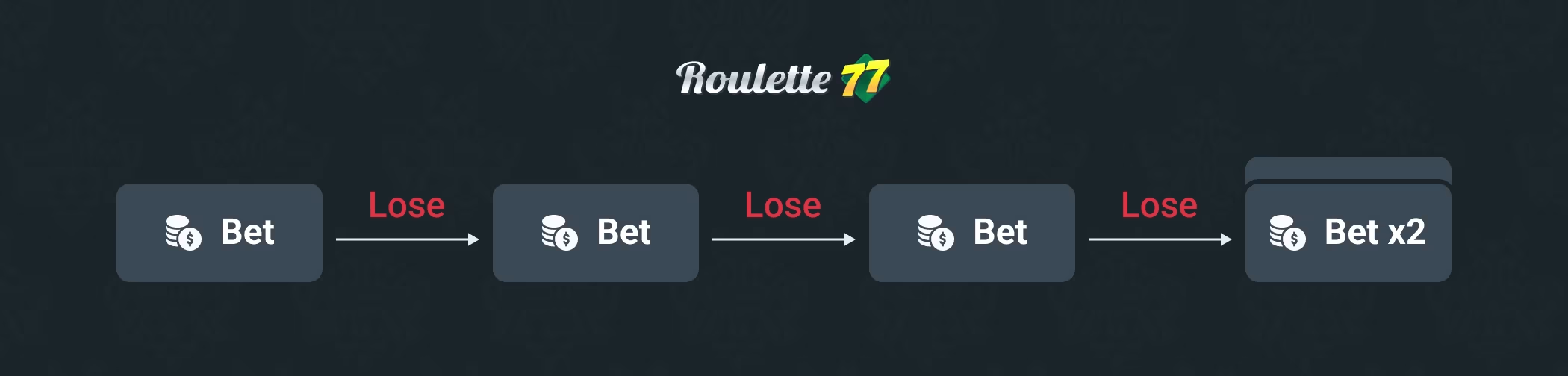
The Piquemouche progression requires bets to be increased at the same rate as in Martingale (2x), but the rate of increase is much slower and is conditional on losing three times in a row. This way, you can extend your playing time and get more opportunities to recover your losses. To illustrate with an example, the Martingale system reaches its ceiling when 9 rounds have been completed. In the Piquemouche system, it takes 27 rounds for this to happen.
However, unlike Martingale, this also means that you cannot recover your losses with a single win. You have to keep playing until you reach a profit, and how long this takes will depend on your progression stage or how the game is going.
Piquemouche Strategy Test with a Simulator
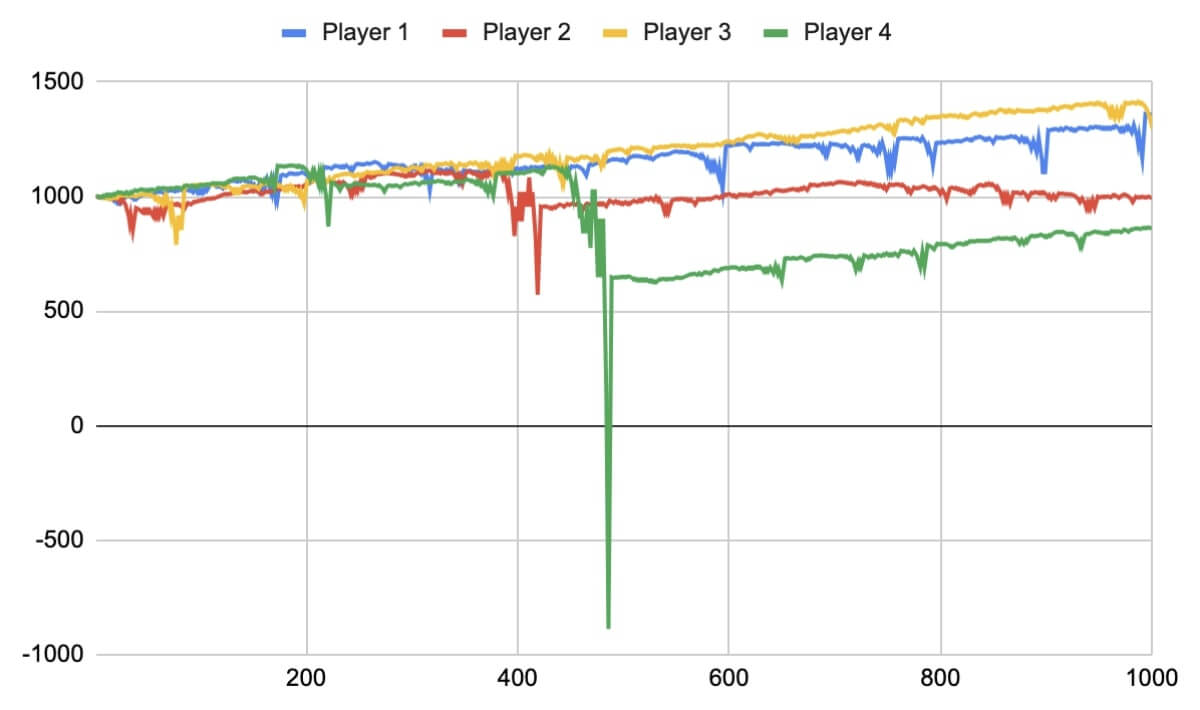
To see what results this strategy would yield in the short and long term, we created a simulation with 4 players. The players had a bankroll of $1,000 and completed 1,000 spins each. In the chart below, you can see how successful (or unsuccessful) they were using the Piquemouche strategy:
Here are the conclusions we can draw from this simulation:
- Player 3 had the best results. He finished the simulation with $1,358 (profit: $358) and although he made a loss in the short term (his bankroll dropped to $790 on spin 78), in the long term he did quite well. In fact, after completing the first 200 spins, he never dropped below his starting budget.
- Player 1 was almost as lucky, finishing the simulation with $1,356 (profit: $356). Both players managed to increase their starting budgets by around 30%. Player 1 had slightly more volatile results, but he also did not fall into negative balance after the first 200 spins.
- Player 2 was a bit unlucky: a big loss on spin 395 had a bad impact on his bankroll. By spin 420, his budget was down to $572. Although he managed to recover after that, he couldn't finish the simulation with a real profit. After 1,000 spins, his bankroll was $1,002 (profit: $2).
- Player 4 was the unluckiest player in this simulation. He was showing promise until halfway (up to spin 459), but after that, he started to lose, and by spin 487, his bankroll was down to -$888, making him completely bankrupt. After that, he started winning, but this terrible loss caused him to end the simulation with $860 (loss: $140). However, it is important to note that this is a simulation of the game; in a real gaming session, after losing $888, it would be more logical to end the game.
Pitfalls of the Piquemouche Strategy
We can say that this strategy has two main and important problems:
- If the losing streak goes on for a long time, you still run the risk of going bankrupt. This risk is lower compared to Martingale, but it still exists. Moreover, in such a situation (as Players 3 and 4 showed) you will hardly be able to recover your losses and make a profit.
- You can still get stuck in the table limits. The Piquemouche progression series has no end, but table limits do. If you reach the maximum limit before the system pays out, you will not be able to increase the wager any further. This will cause the whole system to crash, just like Martingale.
Conclusion
We can recommend Piquemouche to players looking for a strategy as simple as Martingale but not as aggressive. You can use it even if your budget is limited and still get results. However, keep in mind that the main problems of the Martingale variants will still apply here - for example, table limits will be a problem. In addition, the slower progression will require you to score a lot of wins, not just one, in order to make a profit. If you are going to use the Piquemouche strategy, keep these disadvantages in mind.


