








How the Masse Egale System Works
If you are wondering what Masse Egale means, it translates in English to “equal mass”. As fancy as the french name sounds, this system is not fancy at all. It is about as primitive as it gets. The principles are as follows:
- Masse Egale is primarily designed for inside bets such as straight-up, corners, street bets, and six-line bets.
- Choose your bet and stake amount, then make the exact same bet each round.
It’s that simple!
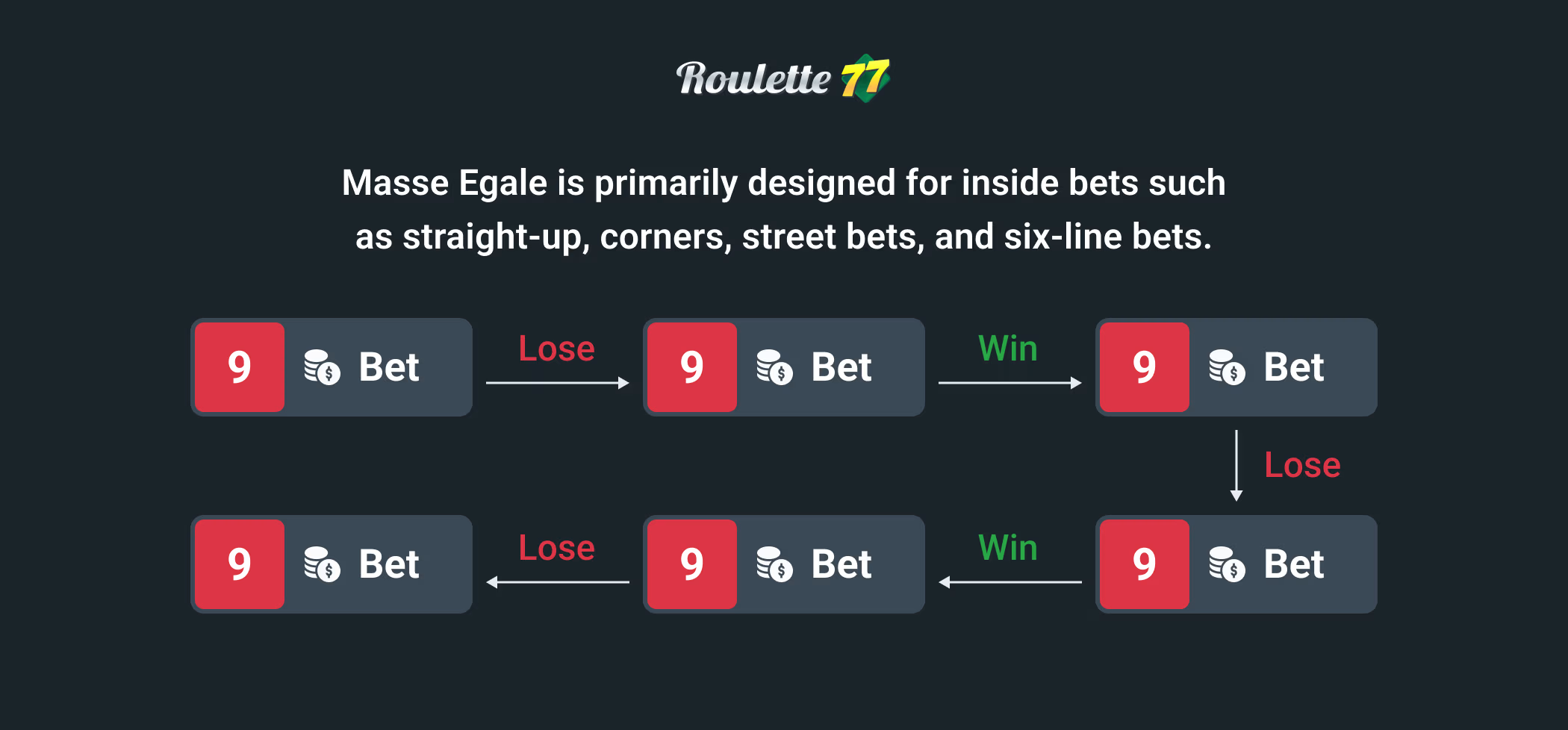
Even though this system is designed for inside bets, it could theoretically be used for outside bets too. It’s just that it probably won’t have much of an effect. Using it to, say, bet on black for 1,000 rounds will likely result in a small gain or small loss. This is because even-money bets have low volatility. Inside bets, on the other hand, are very volatile, which means you can make a decent gain and then quit while you’re ahead.


Putting the Masse Egale System to the Test
For most readers, this system is quite easy to test. We took the probabilities and payout ratios for specific inside bets and entered them into a spreadsheet. We ran simulations for straight-up bets, split bets, and street bets. For each bet, we randomly generated the outcomes over the course of 1,000 rounds. We tested each bet type with stakes of $1, $3, $5, and $10.
We started with a test of straight-up bets, which have a probability of 2.7% and a payout ratio of 35:1. Here are the results:
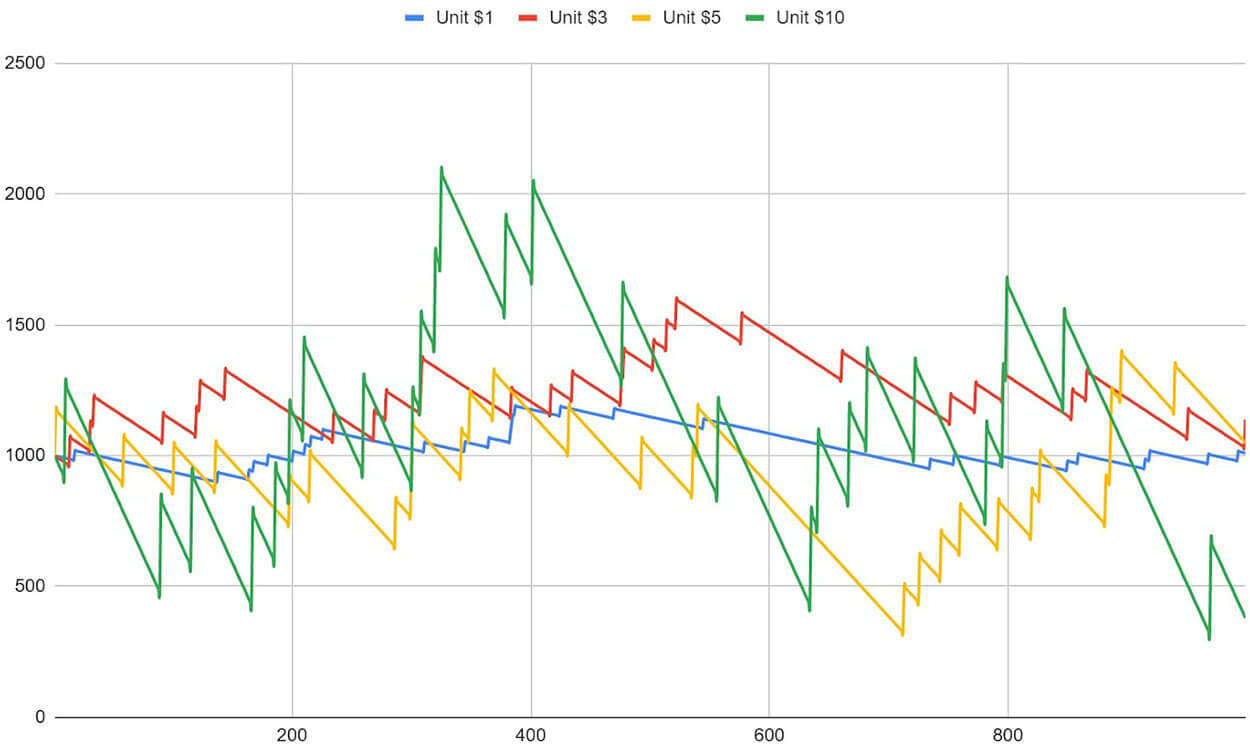
As our simulations usually show, bigger stake amounts cause more amplified ups and downs. Smaller bets cause the bankroll to remain relatively stable. In this case, the $1 bettor’s bankroll didn’t deviate too far from the $1,000 mark. Conversely, the $10 bettor saw his bankroll grow by over $1,000 at one point before eventually plummeting for a net loss of over $500. Perhaps the most remarkable thing was how none of the players came all that close to zeroing out. All of the players could have walked away with a notable profit at one point.
Across regulated markets, we’ll now take a gander at how the Masse Egale system performs when used with split bets. We have a 5.4% chance of winning, and the payout ratio is 17:1.
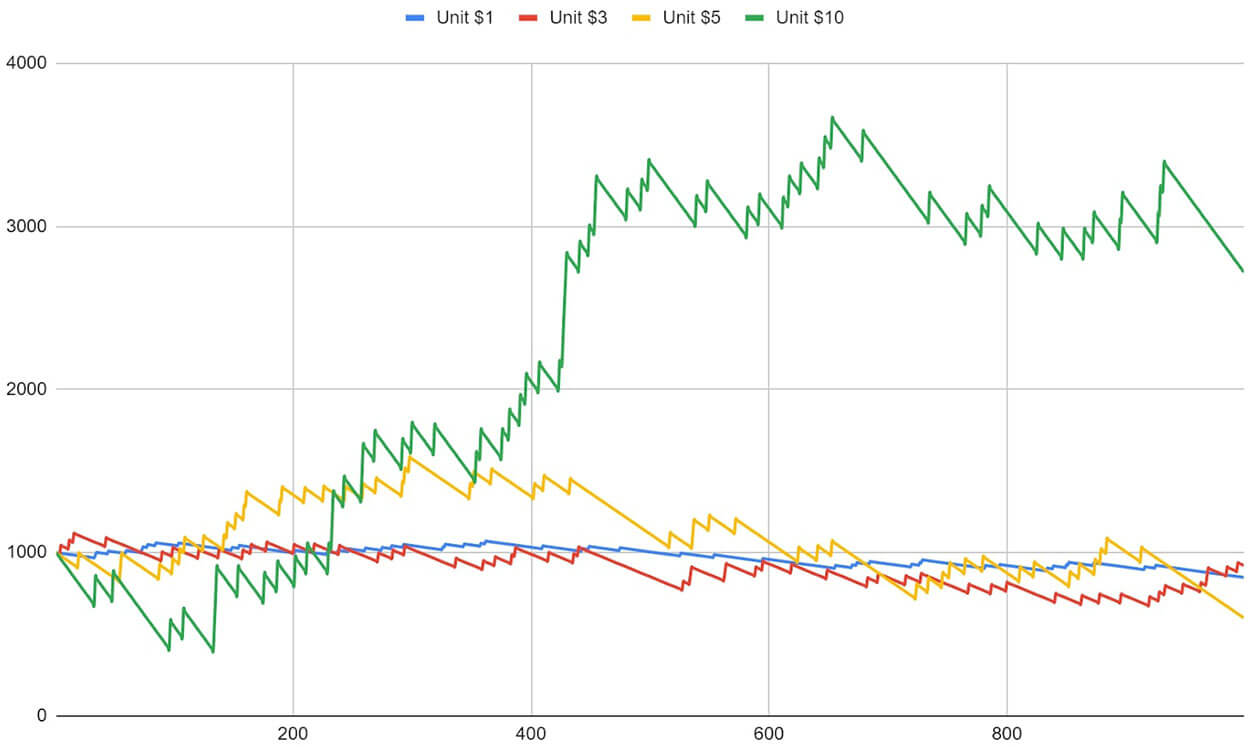
Again, the $1 bettor’s bankroll doesn’t fluctuate much at all. However, the $10 bettor’s bankroll went on quite the wild ride. After losing over half his starting bankroll, he went on a hot streak and finished the session with a huge gain. It’s secure to say that luck was on his side this time.
Now, let’s turn our attention to street bets which have an 8.1% chance of winning and a payout rate of 11:1.
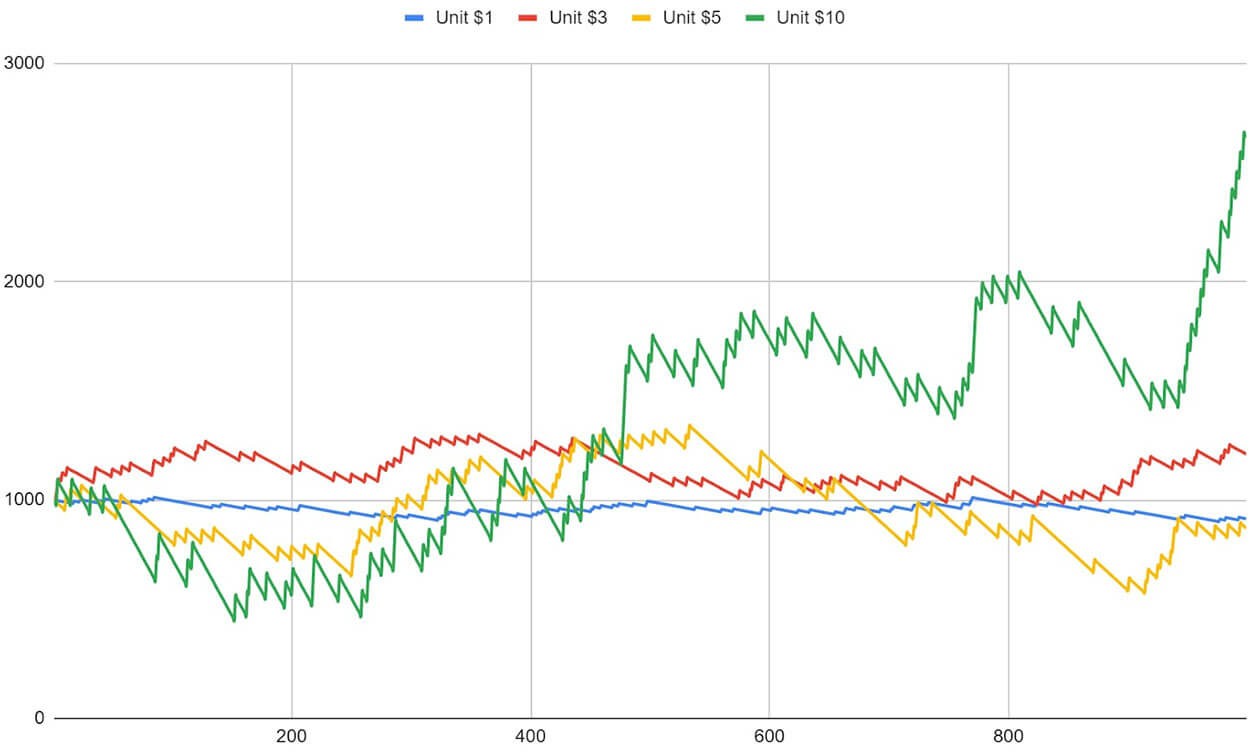
Based on hands-on review, these results are pretty close to the results we got from the split bets. The $1 bettor’s bankroll remained relatively flat, while the $10 bettor’s bankroll acted much more dynamically. Once again, the big bettor had some timely winning streaks and ended up well in the black.
So, what can we say about these results? Well, we can say that Masse Egale isn’t the most failed approach. With a big enough bankroll, you may run with Masse Egale until your bankroll peaks and then bail out a winner. All three simulations gave each player a chance to do this.
Our tests show that such a basic system as Masse Egale can be more effective than many of the more complex and riskier approaches. It’s also worth noting that bigger bets are more effective when using Masse Egale.
Pitfalls of the Masse Egale System
From a mathematical point of view, repeating the same bet over and over will eventually lead to a loss. It doesn’t matter what the stakes are. With split bets, for example, we can expect to win 54 times and lose 946 times over 1,000 spins. After doing a bit of math, this equates to a net loss of just 28 units. However, we all know that the outcomes can be far different in practice. Good timing helps a lot.
Ideally, anyone who uses this system should come into the session with a big enough bankroll. They can also expect that using this so-called system can make the game rather boring.
Conclusion
Masse Egale is a very primitive system that calls for repeating the same bet over and over. As silly as this may sound, our tests show that the system has some merit. By selecting the optimum stake size and the right time to call it quits, it is possible to make a profit. Nevertheless, the overall trend is negative and sticking with the system over the long run will eventually result in a net loss.
We should point out that many “roulette gurus” advise players to avoid inside bets. While we can see their point, we have just shown that repeating the same bet does, in fact, give you a chance to make money. It is too bad that Masse Egale makes the game so boring.


