








How Lucky 7 Strategy Works
The basic principles of this strategy consist of the following:
- Like many other progressive systems, you should prefer even money bets (odd/even, low/high, red/black).
- Multiple sources state that a bankroll of at least $120 will be required and the initial bet amount should be $5. As we will point out below, we don't think this is mandatory, but you can use it as a recommendation.
- You determine what happens to the bet amount based on the round results: if you win, you must increase it by 1.5x in the next round. You keep doing this as long as you keep winning. (If the result is a weird number such as “4.83”, for example, you can round it up or down.)
- If you lose, you go back to the starting bet and repeat the cycle.
- The ultimate goal is to win 7 times in a row: when this happens, the strategy works, and you quit the game. So, you have to keep playing until this happens.
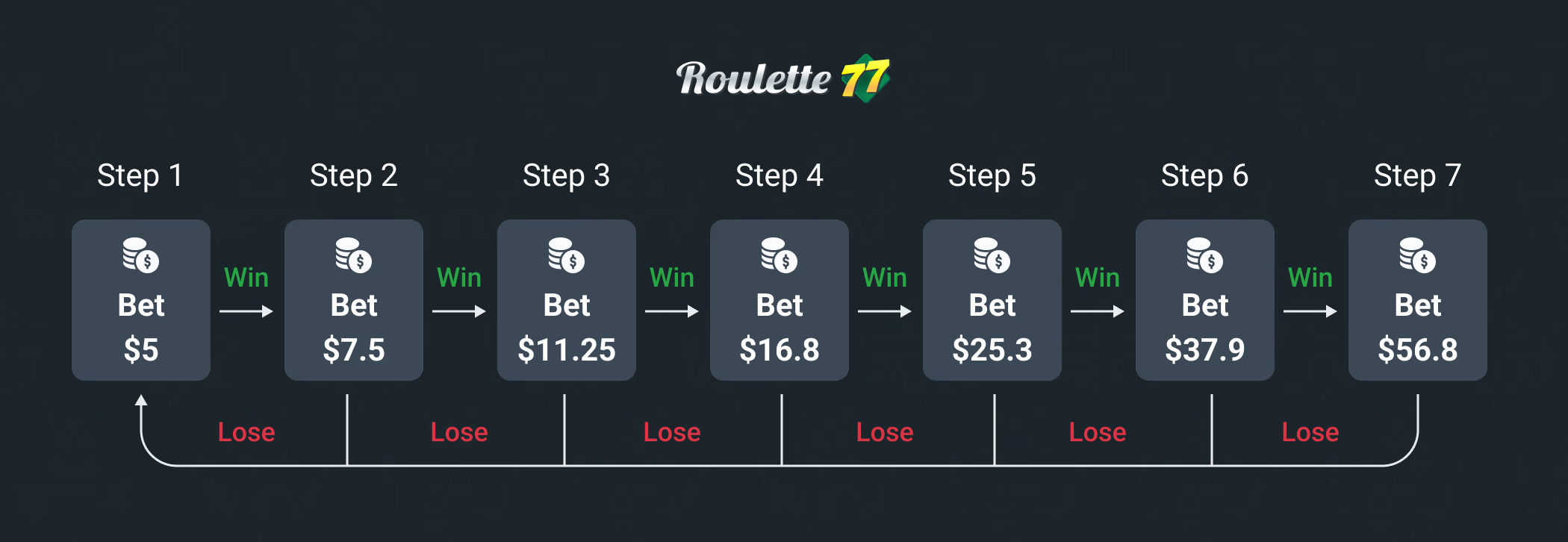
We can say that this is a strategy similar to the Paroli system in some ways, but there is an additional requirement about when you must quit the game (winning 7 times in a row) and the player has more control over the gameplay. If we give an example using 5 spins, you can understand more easily how the system works:
- Spin 1
You start playing with $5 and win.
- Spin 2
The bet amount should be $7.5 (5 x 1.5). Let’s say you win this round too.
- Spin 3
This time, the bet amount will be $11.25 (7.5 x 1.5). And, once again, you win.
- Spin 4
The bet will be $16.87 (11.25 x 1.5), but we can round this to $17. This time, you lose.
- Spin 5
Since you lose, we go back to the beginning: the bet will be $5.
Lucky Seven Roulette System Simulation
Using a simulation, we wanted to see what the long-term results of the system would be, that is, whether it really worked. We performed this simulation using the following parameters:
- We created three players and gave each of them a bankroll of $1000.
- We had each of them do 500 spins.
- We set the starting bet amount of each to $5.
In the image below, you can see the simulation results. The X axis shows the number of spins, and the Y axis shows the balance (bankroll) amount. In other words, you can see what changes have occurred in the bankroll over time. We did not round up or down the bet amounts in the simulation, as this would not affect the system in any way. (The rounding recommendation is made so that you can simply calculate the 1.5x increase; it is not necessary in a simulation.)
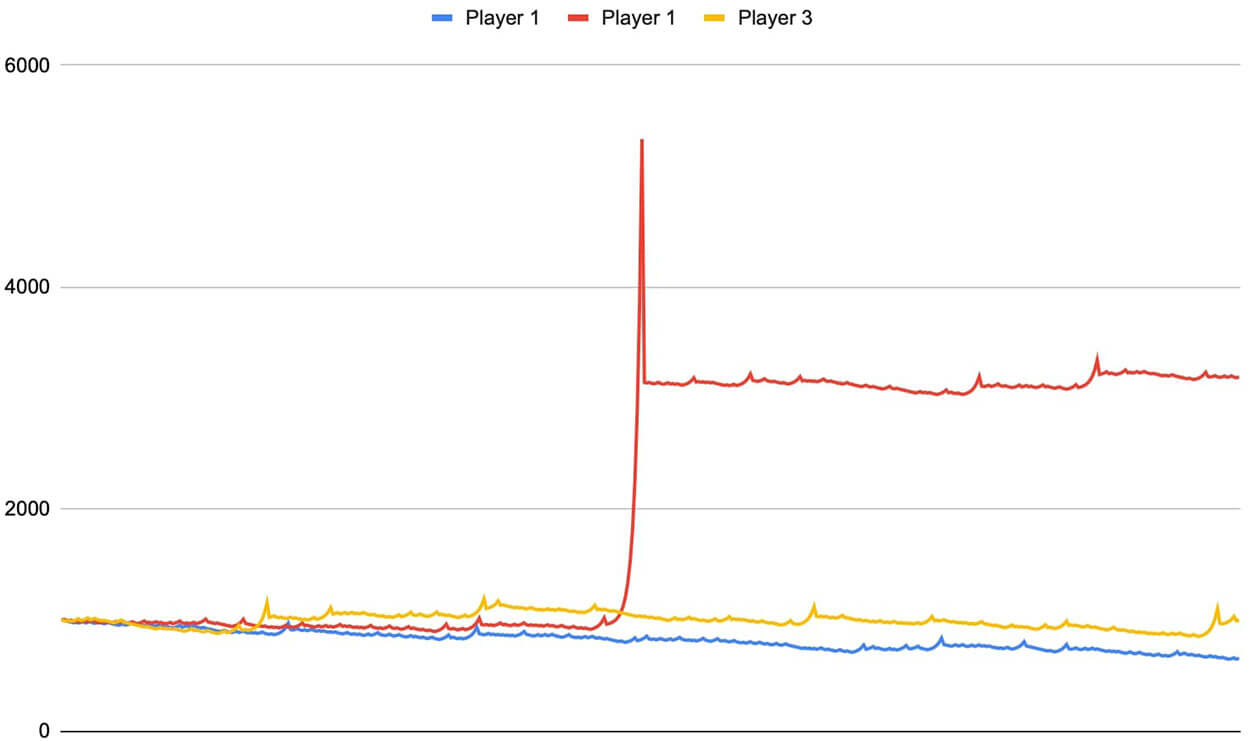
We mentioned above that the system works (and ends) when 7 wins in a row occur, so let's start by looking at when this happens for each player.
- The first player failed to win 7 times in a row throughout 500 spins. He was able to do this no more than 6 times and finished the simulation with a bankroll of $652, meaning he lost $348.
- The second player started a streak on spin 234 and managed to win 7 times in a row. He finished the game on the 240th spin and his balance was $1208, meaning he made a profit of $208.
- The third player started a streak on spin 81 and managed to win 7 times in a row. He finished the game on the 87th spin and his balance was $1066, meaning he made a profit of $66.
Main Problems of the Lucky Seven System
The fact that two players have made a profit may give you hope, but you need to understand how unlikely this is. Let's say you bet on “black” in a single-zero roulette game. This wheel has 37 numbers and you bet on 18 of them. So:
- 18/37
- 0.4864
- 48.64%
Your chance of winning this bet is 48.64%. But remember we have to win seven times in a row for this strategy to work. We can find the probability of this by calculating the seventh power of 0.4864. So:
- 0.4864 x 0.4864 x 0.4864 x 0.4864 x 0.4864 x 0.4864 x 0.4864
- 0.00644
- 0.6%
Your chances don't seem that good anymore, do they? Moreover, as the simulation results show, you need to play for quite a long time to get 7 consecutive wins: if you start with a low bankroll, you will most likely go bankrupt before the strategy works.
Conclusion
The Lucky Seven strategy has some advantages. Since we only increase the bet amount after winning, the overall increase occurs more slowly and in a controlled manner. So, losing repeatedly will not reduce your bankroll very quickly. Also, since the boost rate is only 1.5x, it will take longer to reach table limits. Finally, the strategy has a clear promise, for it to work you know what your goal is: if you win seven times in a row, you will make a profit.
These are important advantages, but the main problem is that your odds of winning seven times in a row are very, very low. Are you sure you want to rely on a 0.6% chance? Moreover, even if you somehow manage to do this, there will be no certainty about the results. In our simulation, one player made a profit of $66 and the other made a profit of $208, there is a significant difference between them. The fact that the profit amount is not predictable makes the entire strategy questionable. If you are going to use the Lucky Seven strategy, consider limiting the increase to the bet amount on consecutive wins, otherwise you may go bankrupt before the system produces a result.


