








How Kavouras Strategy Works
It is very easy to use the system because it is clearly stated which bets you will choose and what the wager amounts will be. The strategy works like this:
- Place a 1 unit bet for the 0, 1, 2, 3 corner.
- Place a bet of 2 units for the 31, 32, 33, 34, 35, 36 line.
- Place a 1 unit bet for the following splits: 8-11, 4-13, 15-18, 17-20, 27-30.
That’s all: you always pick the same bets, and you always place the same wagers. So, what do you get in return?
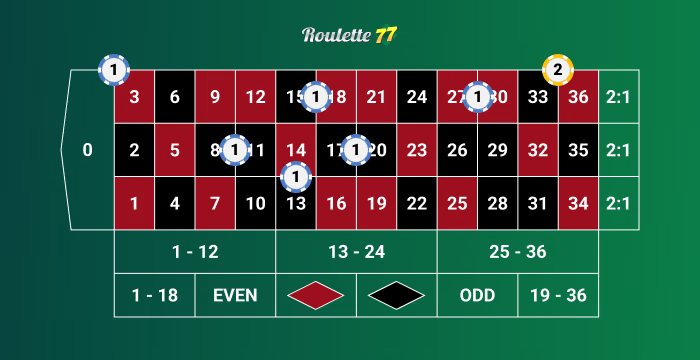
These are not randomly chosen numbers: they are determined by taking into account the sectors of the roulette wheel, and when you win any of them, you can make a profit. With this combination, you can cover a total of 20 outcomes, which significantly increases your chances of winning. More precisely, your chances of winning in single-zero roulette are:
- 20/37
- 0.540
- 54%
Possible win/loss scenarios are as follows:
- If the corner bet wins, you make +1 profit.
- If the line bet wins, you make +4 profit.
- If one of the split bets wins, you make +10 profit.
- If you do not win any of the bets, your loss will be -8.
Let's try to explain how the system works with an example that includes five spins and let's assume you start playing with 10 units.
- Spin 1
You win the corner bet. Bankroll: 11 units (+1 profit)
- Spin 2
You win the line bet. Bankroll: 15 units (+4 profit)
- Spin 3
You did not win any bets. Bankroll: 7 units (-8 loss)
- Spin 4
You win one of the split bets. Bankroll: 17 units (+10 profit)
- Spin 5
You did not win any bets. Bankroll: 10 units (-8 loss)
So, even if you have two losses in a series of five spins, you do not go below your initial bankroll. But remember that this is a scenario: In real life, results will of course differ. The simulation we have prepared for this strategy will show this more clearly.


Our Test of Kavouras Strategy
It is very easy to create a simulation for flat betting systems because the parameters you should use are quite simple. Since the betting options and wager amounts do not change, all we have to do is determine the number of players, give them a bankroll, and have them complete a couple of spins.
When comparing platforms, that's exactly what we did. We selected three players, gave each of them a bankroll of $1,000, and continued the simulation until they all completed 500 spins. The reason we keep the number of spins high is that we want to see not only the short-term but also the long-term results of the approach. You can see the simulation results in the image below:
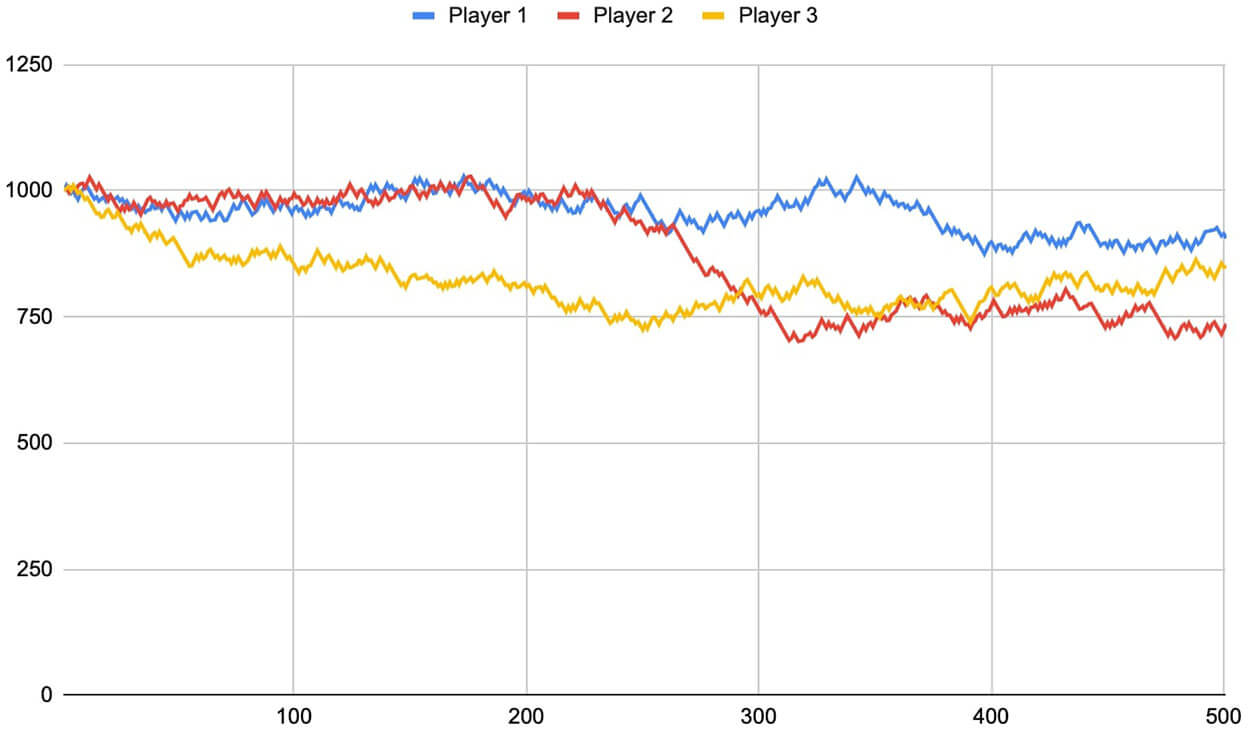
- Player 1 completed the simulation with $906 (loss – 4 units)
- Player 2 completed the simulation with $735 (loss – 265 units)
- Player 3 completed the simulation with $849 (loss – 151 units)
It's no surprise that the approach fails in the long run, because if you keep playing, eventually the math will work against you. In other words, there is no approach that continues to produce successful results over the long term. We only see the effect of the 54% chance of winning in the short term (within the first 100 spins) and it is not that notable of an effect. Except for Player 3 being especially unlucky, the short-term results are in line with our expectations: no radical changes in the bankroll, either up or down, occur. This is something you may expect to see as long as your chances of winning range between 50-55%.
Pitfalls
From our testing, the top thing about flat betting systems is that they are very easy to use. It's obvious what you should do, and you just repeat what you did initially, you don't need to change/adjust anything. However, it is not possible to say that they really work for the same reason, because no matter how much you increase the chances of winning, you maynot beat mathematics: the casino will eventually beat you.
Since you maynot change the house edgeFor most readers, it is not possible to gain any benefit from flat betting systems, except for a few statistical deviations in the short term. These are also valid for the Kavouras Bet System: Kavouras says that the wager amount can be changed, but doesn’t give any details, but even if he did, it will not make a difference since the combinations will not change.
Conclusion
Ioannis Kavouras has created a simple system that gives you a 54% chance of winning, that’s all. We cannot say that it creates any benefits for players, but it is easy to use and doesn’t ask you to take big risks. If you are looking for a straightforward approach that increases your chances of winning to just over 50% and is suitable for any bankroll, you may use it, but don't expect miracles.


