








How the system works
This is not a difficult system to understand, and you don't need a big bankroll to implement it. In some scenarios, it's also possible to get surprisingly satisfying results. In other words, it's everything you'd expect from a roulette strategy: it allows you to get decent results without spending a lot of money. To use the John Wayne system, you need to follow these steps:
- Select any two numbers in the middle column (e.g., 5 and 32).
- Place a chip on each of these numbers.
- Also, place additional chips on the corners of both numbers.
In the image below, you can see what this looks like:
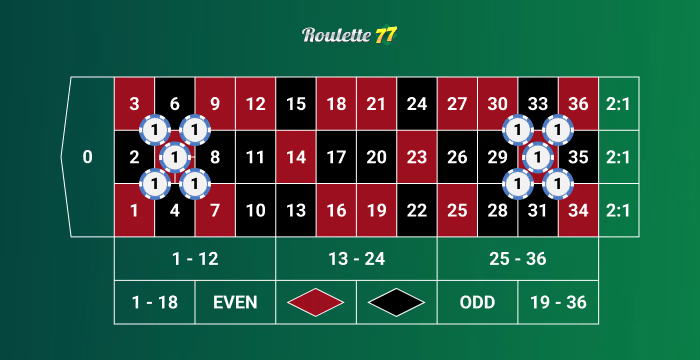
By doing this, you will have placed a total of 10 chips and covered 18 outcomes. So, this allows you to place a bet that covers roughly half of the roulette table. You don't need to change anything: you can repeat these bets (without even having to change them) until you get the results you want. In each round, there are four possible outcomes:
- If the outcome is one of the outer corners, such as 1, 3, 7, 9, 28, 30, 34, and 36, you lose one chip.
- If the result is a number between corners such as 2, 4, 6, 8, 29, 31, 33, and 35, you win eight chips.
- If one of the two chips you placed in the second step wins, you get paid 62 chips.
- You drop ten chips when you lose.
Testing the John Wayne system
To test this system, we created a simulation with four players and gave each of them a bankroll of 1,000 units. The players placed their bets according to the rules explained above and completed 400 spins in total. You can see what happened to their bankroll at the end of the simulation in the image below:
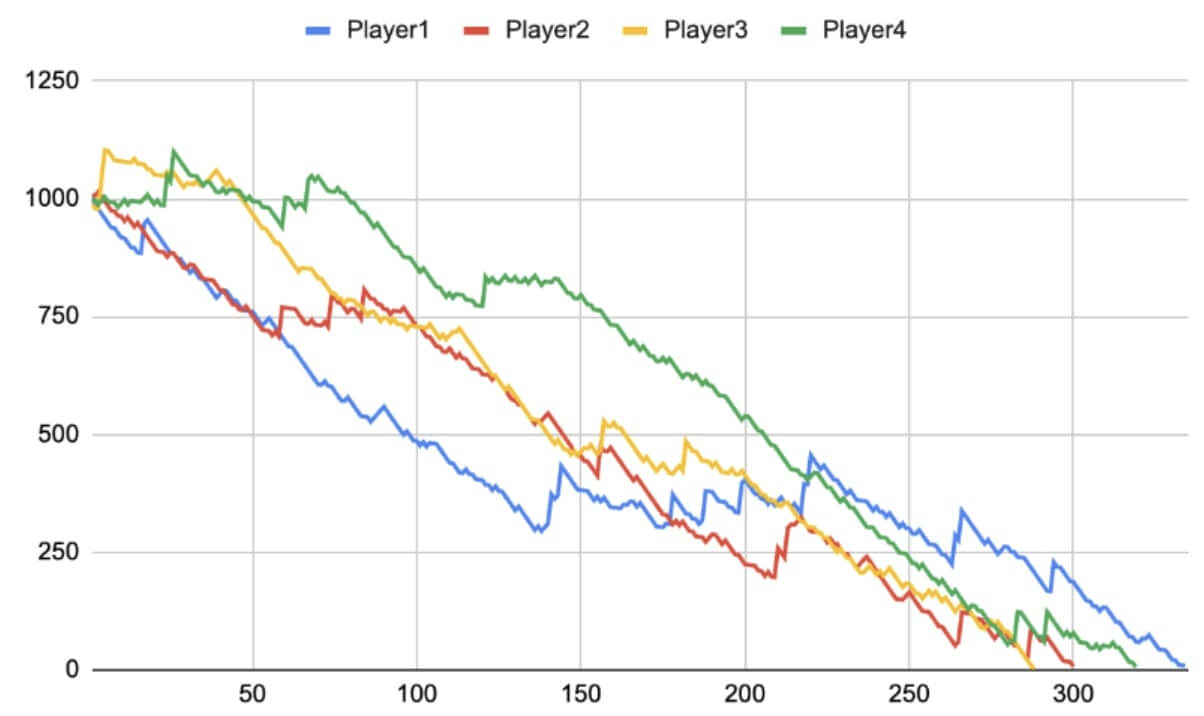
For the first 50 spins, things didn't seem to be going too badly (that's what we meant by the surprising results above), but as we kept playing, the results got worse. You can use this system by spending 10 units per round, so you don't have to take a high risk every time, but there is still a risk of going bankrupt before you reach 100 spins. All of our players, even those who profited for a while, went bankrupt before completing the first 100 spins. After that, they were not able to recover, because even if they won from time to time, the payouts were not big enough to compensate for their losses.
Problems with the John Wayne System
Using this system for 10-15 spins may mislead you because you may think you are getting results. But if you keep playing, your bankroll will decrease with almost every spin and after a while, even if you win, the payouts will not be big enough to cover your losses. So, you won't just go bankrupt, you will be in a permanent bankruptcy situation.
The system is completely inadequate in terms of how losses can be recovered, as it has no rules on bet sizes, and even if you can cover half the table, it doesn't mean much. Let's say you have a 50% chance of winning with this system: this means that you also have a 50% chance of losing, and in the long run this will work out in favor of the casino. So:
- It's not reasonable to expect the John Wayne system to work when even strategies that allow you to cover more than half of the table don't work. It's basically a strategy that tries to increase your chances of winning and as we all know, this would be a pointless goal as the RTP/house edge values won't change.
- The system has no scenario for loss recovery. For example, as soon as your bankroll goes negative, it doesn't ask you to increase the stake to get it back to positive. This makes loss recovery impossible and locks you in a perpetual state of bankruptcy.
Conclusion
You might consider using the John Wayne system for gaming sessions of 5-10 minutes and/or a maximum of 20 spins, as you get a good chance of winning without breaking the bank. However, due to the mathematics of roulette, these chances are meaningless in the long run, and you will not be able to avoid bankruptcy if you continue to use this system. Therefore, for longer gaming sessions, it is much better to use another strategy.


