








How Freddy’s Triangle Betting Strategy Works
The goal of the strategy is to come out in profit after you finish all the numbers. You should prepare a solid bankroll and consider that you will only be betting on even money bets. So, the strategy only involves changing the bet size, and the bet remains the same. You can choose which even-money bet you will play, but we’ll stick with Red/Black for simplicity.
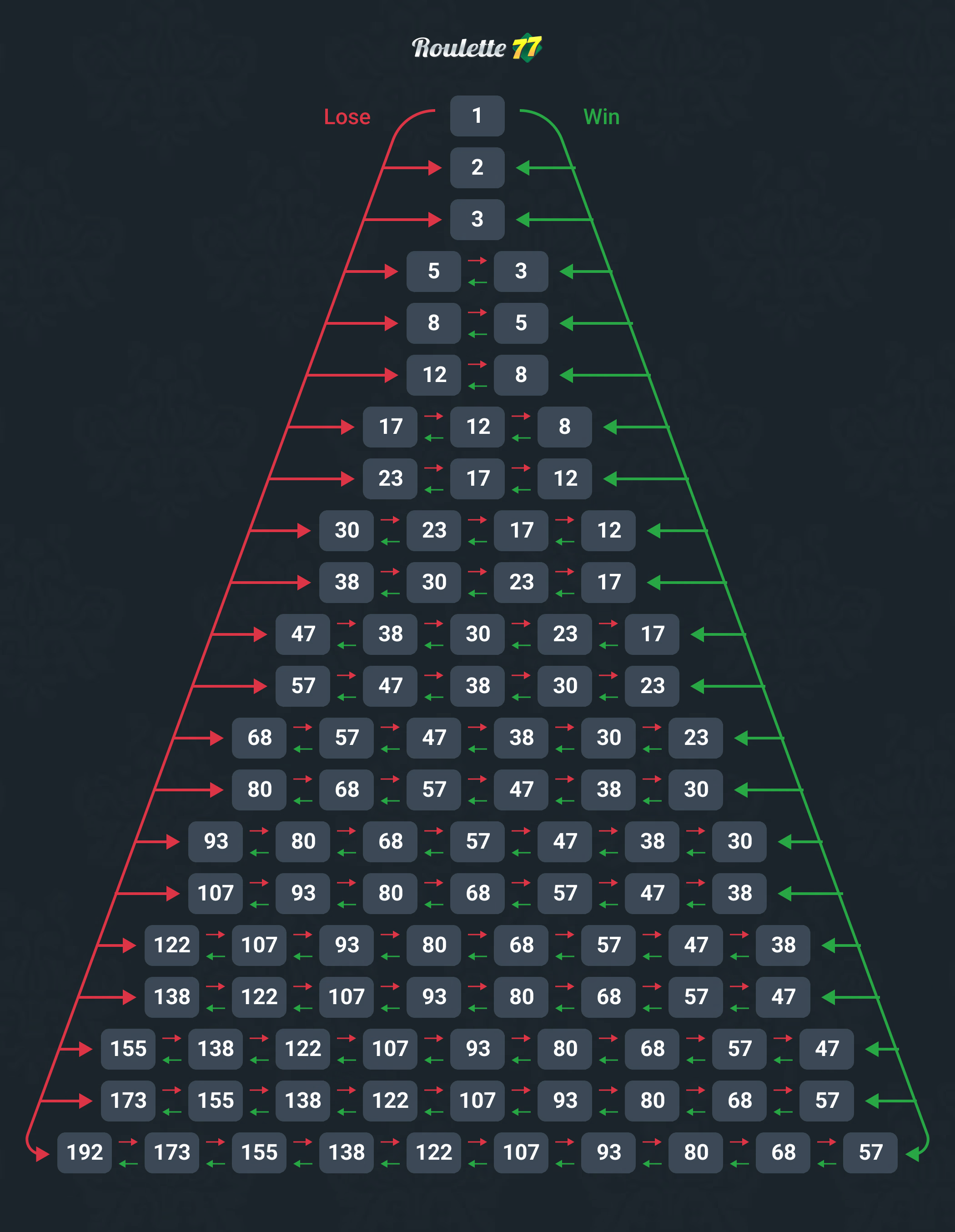
Before we get to how the strategy works, we’ll present you with the sequence, or the ‘triangle’ itself. Check it out before we proceed.
Now, let’s get to the strategy.
We will start with the first bet, and the unit size is 1 - the number on the top of the triangle. If you win, you go right on the same row you’re at on the triangle. If you lose, you go one row down and start from the left. Since the first 3 rows only have 1 number each, if you win, you will wager $1 again, and if you lose, you will wager $2. If you lose again, you will wager $3. If you lose your $3 wager, you continue with the row down, starting from the left, which is number 5. This means that you will now wager $5.
If you win, your next wager will be the number on the right in the same row - which is number 3. If you lose, you go one row down and start on the left, which is number 8. If there are no more numbers on the row and you win, you place the same bet. Once you reach the bottom row, the game ends. The strategy doesn’t say what to do if you reach the bottom row and you lose, though.
Putting Freddy’s Triangle Strategy to the Test
To see how the Freddy’s Triangle strategy works in practice, we decided to put it to a test. For our test, we setup a Google Sheets simulation with 500 rounds with 4 players, with each one of them starting with a bankroll of $1,000.We used European roulette, where the chances of winning for even-money bets are 48.65% for each spin and each player. All players started with the starting bet of 1 unit, and continued with the strategy.
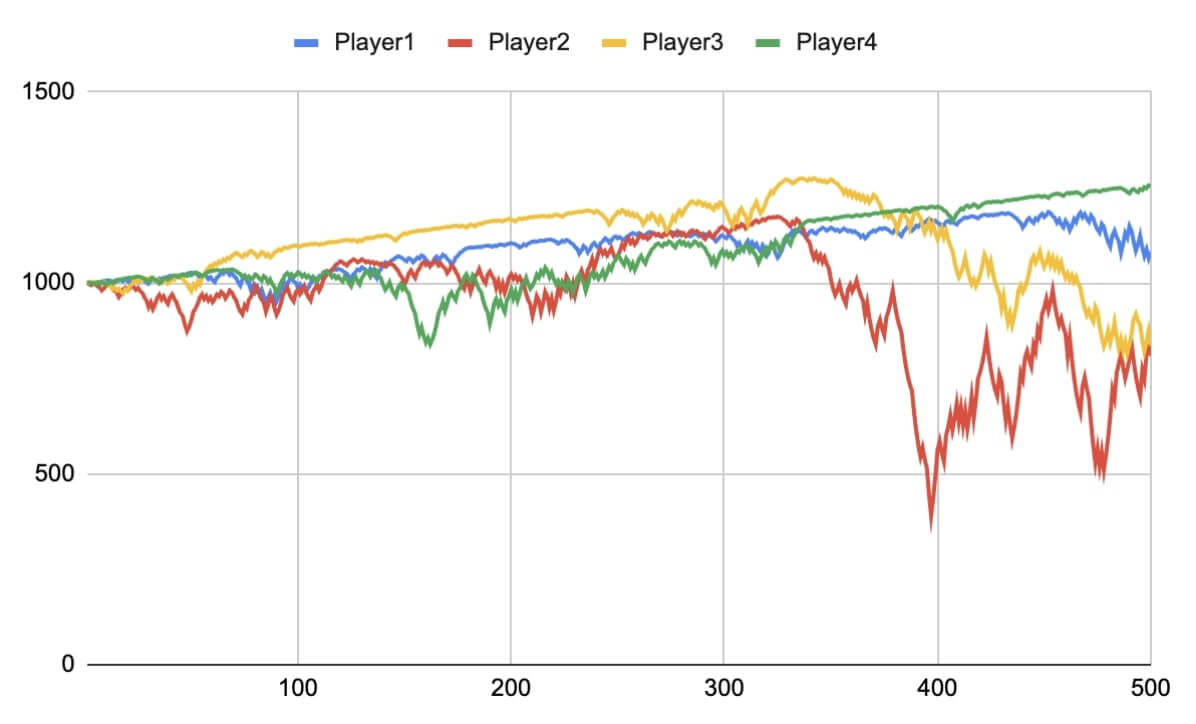
As you can see in the chart, Player 2 had some major fluctuations and finished the 500 spins simulation in net loss. At one point, his bankroll fell to $390, although he managed to come back by spin 450 and be in a minor net positive, only to lose a few bets again.
Player 3 also ended the session with a net loss of $164, but their bankroll never fell below $800. Player 1 finished in net profit, but a series of losses by the end of the simulation meant that he finished the session with some minor profit. Player 4 was the most successful one by the end, even though their bankroll fell below $1,000 many times, especially after experiencing several losses in a row by spin 160. In the end, they made $253 in profit.
Pitfalls of the Freddy’s Triangle Strategy
Although 2 of the 4 players ended in a profit, the most significant pitfall of the strategy is the fact that it doesn’t say what to do if you lose while you’re on the last row. Also, our simulation showed that you can experience some major swings, which means that you should be comfortable with betting larger amounts in a single spin to come back. Overall, the strategy can work, but it’s not much different than the standard Martingale strategy.
Conclusion
Freddy’s Triangle is an interesting strategy that has the potential to work, but, like most strategies based on the Martingale strategy, it is heavily based on luck. It’s a balanced system, but you might be required to have a larger bankroll, especially in the second half of the game, so we suggest starting with a lower unit size of $1 or even lower. Also, we suggest you don’t underestimate the bankroll requirements from the start because the bet sizes get progressively bigger the lower you go on the triangle.


