








How Finals System Works
The system looks a little complicated, but it's actually quite simple, as all you have to do is follow the spin results and take notes. (In this context, remember that you will need to use something you can take notes on, such as pen and paper, in order to use the system.) Here's what you need to do:
- Wait for 39 spins to be completed and note the winning numbers on each one. (At this stage you are not placing bets, you are just an observer.)
- Analyze results and create 7 final groups from the winning numbers (create the list we shared above based on their last digits).
- Note how many numbers are in each group. (If a number appears more than once, you must count it only once.)
- Identify the group in which numbers appear once. (If a group did not appear, do not choose it, and if two groups appear one time each, so choose both)
- Bet on your chosen Final Group for 9 rounds or until you win. Bet to Final Group means that you should bet straight-ups to separate numbers of the chosen group
You can understand more clearly how the system works in the examples below. Simply put, we find the least frequent numbers in a roulette game and assume that these have an increased chance of winning. Gamblers also made this assumption at the Monte Carlo Casino in 1913, and although more than a hundred years have passed, we still remember this incident. We'll explain what this means below, but let's give examples first.
Our Test of Finals System
For this test, we chose three players and gave each of them a bankroll of $500. As requested by the system, we first completed 39 spins (we used an RNG for this), created final groups with the results, and placed 9 straight bets using the group with the fewest numbers.
The spin results for Player 1 were: 31, 4, 13, 36, 4, 27, 16, 4, 4, 31, 3, 14, 6, 3, 31, 14, 8, 24, 22, 9, 32, 2, 8, 28, 33, 11, 8, 21, 23, 23, 26, 14, 29, 15, 1, 0, 27, 30, 6
With these, we created the following final groups:
- 0, 30
- 31, 31, 31, 11, 21, 1
- 22, 32, 2
- 13, 3, 3, 33, 23, 23
- 4, 4, 4, 4, 14, 14, 24, 14
- 15
- 36, 16, 6, 26, 6
As you can see, the fewest numbers are in the final group of 5. The numbers in this group are 5, 15, 25, and 35. Let's place straight bets using these.
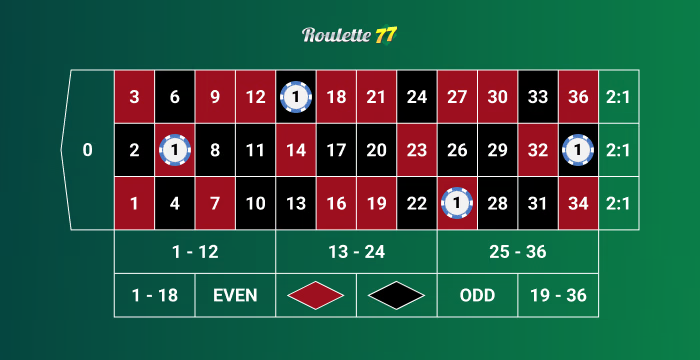
These are the results of those bets:
| Round | Outcome | Result | Wager Amount | Payout | Bankroll |
|---|---|---|---|---|---|
| 1 | 32 | loss | 4 | -4 | 496 |
| 2 | 36 | loss | 4 | -4 | 492 |
| 3 | 17 | loss | 4 | -4 | 488 |
| 4 | 6 | loss | 4 | -4 | 484 |
| 5 | 36 | loss | 4 | -4 | 480 |
| 6 | 8 | loss | 4 | -4 | 476 |
| 7 | 9 | loss | 4 | -4 | 472 |
| 8 | 20 | loss | 4 | -4 | 468 |
| 9 | 25 | win | 4 | 32 | 500 |
Player 1 was only able to win the ninth round and finished the game with a bankroll of $500. In other words, he made neither profit nor loss.
Now it is time to test the luck of the second player. These were the spin results for him: 30, 9, 16, 20, 3, 8, 9, 14, 9, 33, 6, 27, 22, 18, 7, 32, 27, 14, 5, 29, 36, 11, 26, 32, 29, 17, 21, 8, 11, 26, 11, 31, 23, 33, 27, 20, 1, 8, 31
These are the final groups created with these results:
- 30, 20, 30
- 11, 21, 11, 11, 31, 1, 31
- 22, 32, 22
- 3, 33, 33
- 14, 14
- 5
- 16, 6, 36, 26, 26
4 and 5 are the groups with the fewest numbers. So, for the next 9 spins, we will place straight bets for the numbers in these groups (4, 14, 24, 34, 5, 15, 25, 35).
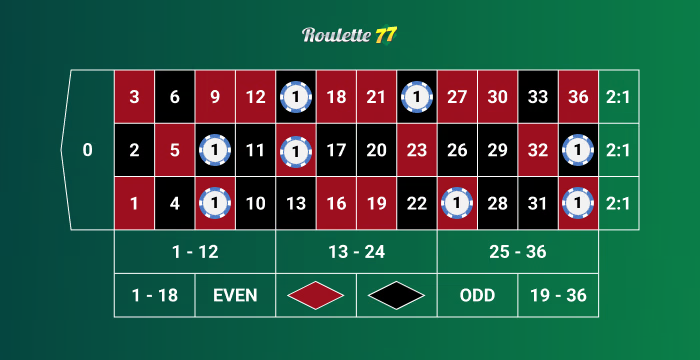
And the results of these straight bets are:
| Round | Outcome | Result | Wager Amount | Payout | Bankroll |
|---|---|---|---|---|---|
| 1 | 23 | loss | 8 | -8 | 492 |
| 2 | 19 | loss | 8 | -8 | 484 |
| 3 | 14 | win | 8 | 28 | 512 |
| 4 | 36 | loss | 8 | -8 | 504 |
| 5 | 8 | loss | 8 | -8 | 496 |
| 6 | 0 | loss | 8 | -8 | 488 |
| 7 | 6 | loss | 8 | -8 | 480 |
| 8 | 7 | loss | 8 | -8 | 472 |
| 9 | 26 | loss | 8 | -8 | 464 |
Once again, there is a single win in 9 rounds. But since it happened very early in the session, there is no profit: Player 2 lost $536 and completed the session with a bankroll of $464.
Now, let’s take a look at our third player, shall we? The spin results were the following: 17, 36, 9, 32, 0, 35, 5, 10, 19, 22, 0, 19, 9, 34, 36, 13, 19, 20, 9, 36, 21, 22, 15, 18, 1, 12, 0, 11, 31, 8, 26, 20, 14, 15, 14, 16, 24, 35, 36
The final groups are:
- 0, 10, 0, 20, 0, 20
- 21, 1, 11, 31
- 32, 22, 22, 12
- 13
- 34, 14, 14, 24
- 35, 5, 15, 35
- 36, 36, 36, 26, 16, 36
Since group 3 has the fewest numbers, we will use its content (3, 13, 23, 33) to place straight bets for 9 spins. Here are the results:
| Round | Outcome | Result | Wager Amount | Payout | Bankroll |
|---|---|---|---|---|---|
| 1 | 10 | loss | 4 | -4 | 496 |
| 2 | 34 | loss | 4 | -4 | 492 |
| 3 | 34 | loss | 4 | -4 | 488 |
| 4 | 6 | loss | 4 | -4 | 484 |
| 5 | 4 | loss | 4 | -4 | 480 |
| 6 | 6 | loss | 4 | -4 | 476 |
| 7 | 34 | loss | 4 | -4 | 472 |
| 8 | 23 | win | 4 | 32 | 504 |
| 9 | 36 | loss | 4 | -4 | 500 |
Exactly the same as Player 1: one win, no profit, no loss. Player 3 completed the test with the same bankroll he began with, $500.
Pitfalls of Finals System
The central paradox lies in the fundamental premise we initially discussed: the independence of each outcome from preceding ones. This principle was reaffirmed by our exhaustive testing. Despite investing considerable time, there was no observable tendency for uncommon outcomes to manifest more frequently in subsequent trials.
It's plausible that scenarios may arise where no specific group corresponds to the dropped number. In such instances, improvisation becomes imperative.
Adopting this system necessitates meticulous observation over 39 rounds, meticulously noting each outcome. Subsequently, one must swiftly strategize and place a bet on the 40th round, armed with insights gleaned from prior rounds.
Conclusion
With the Finals system, all you do is place 9 straight bets. If you are playing single zero roulette, your chance of winning will always be 2.70%. Keeping track of the previous 39 spin results does not give you any advantage. Feel free to use it if you want because you are not taking any risks, but do not be fooled into thinking that your chances of winning will increase.


