








How the Roulette ATM System Works?
The system is actually not very complicated as it is based on only two bet types: low and dozen. Each round, you try your luck with these two bet types, and you have to change the bet amount depending on the win/loss result. Getting started is quite easy as you just need to do the following:
- Place 3 chips for the low bet (this bet covers all numbers from 1-18).
- Place 2 chips for the 3rd dozen bet (this bet covers all numbers from 25-36).
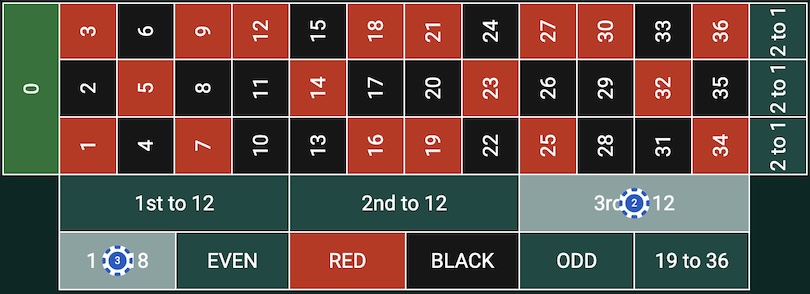
Easy, right? By placing these bets, you cover a total of 30 outcomes. If you are playing European roulette, you will have tried your luck on 30 out of 37 outcomes - this means that you have over 80% chance of winning.
If you win, no problem - you can continue to use the system in the same way. But if you lose, you are asked to increase the stake without changing the bet types. There are three scenarios for this:
- After the first loss: Increase the chip count to 9 for the low bet and 6 for the dozen bet.
- After the second loss: Increase the number of chips to 33 for the low bet and 22 for the dozen bet.
- After the third loss: Increase the number of chips to 74 for the low bet and 36 for the dozen bet.
- If you win at any time, go back to the starting bet values.
There is no explanation of what to do if you lose a fourth time: the ATM system does not take this possibility into account at all (probably because the probability of losing four times in a row is very low). Let's explain how the system works with a simple example:

So, does it work to cover so many outcomes and radically increase bet amounts in case of loss? Let's try to answer this question by testing the ATM system through a simulation.
Testing the ATM System
Our test consists of 500 spins and involves four players. We gave them each a starting bankroll of 1,000 units and let them play according to the rules of the ATM system. Below, you can see the results:
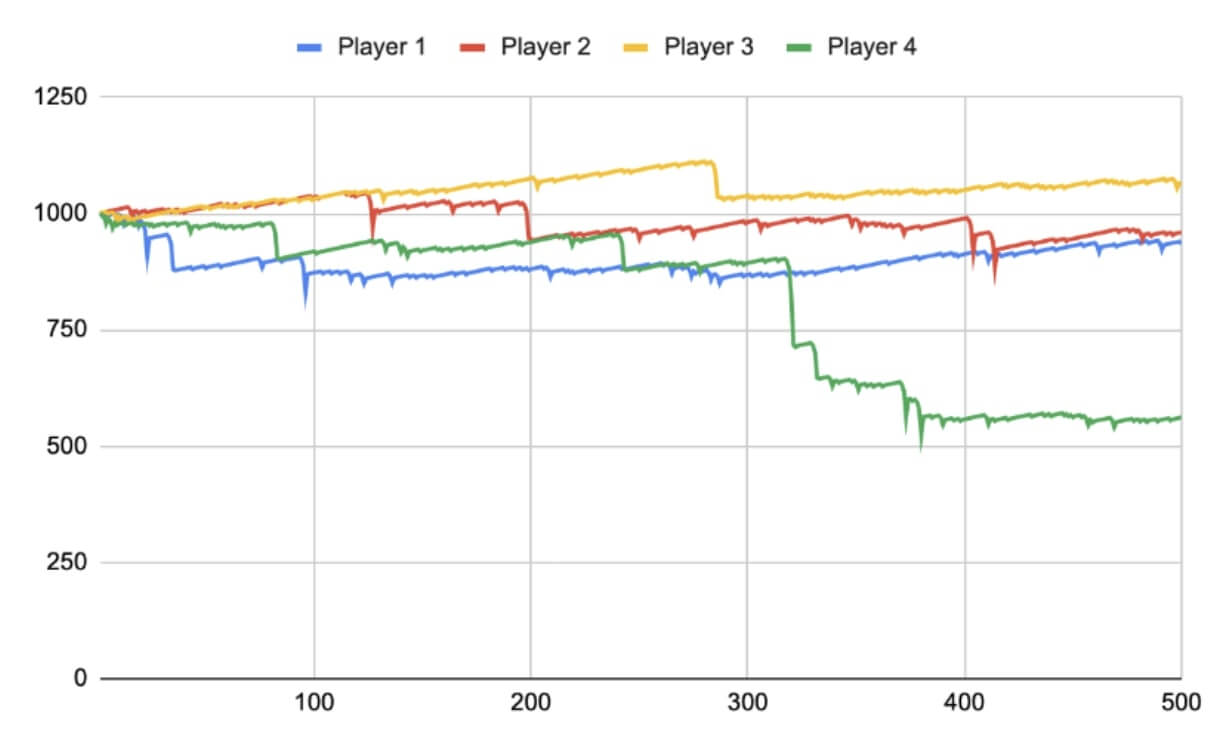
- Player 3 finished the simulation with a profit of 67 units and was the player who increased his bankroll the most, reaching 1,111 units on spin 275.
- Players 1 and 2 finished the simulation losing 65 units and 40 units respectively.
- Player 4 lost 438 units after 500 spins and was completely bankrupt.
Main Problems of the ATM System
This is a system that offers a high chance of winning but can be extremely volatile. It assumes that it will not be possible to lose more than three times in a row, but this is still a possibility, and in such a case you will not be able to come back from bankruptcy, as the payouts will no longer be enough to cover your losses. Even with an 80% chance of winning, losing in rows can happen with surprising frequency. This is evidenced by the volatility that can be seen in the simulation results.
The bet increase in case of a loss is also quite aggressive. Even in most Martingale-based variants, it is quite difficult to see such high rates. You may need to increase the bet by 3x - 4x. If you are already playing with high stakes, even a single loss can cause you to go bankrupt. Such a strategy may be useful for medium-sized bankrolls during short gaming sessions, but in the long run it will be useless as roulette mathematics will work in the casino's favor.
Conclusion
In addition to increasing your chances of winning, the ATM system also tries to manage your budget, but it does so quite aggressively and has no real solution to bounce back from bankruptcy as it assumes that the player cannot lose more than three times in a row. You can use it in short game sessions due to the 80% chance of winning, but we recommend not using it as a long-term strategy.


