








How Askot System Works
The algorithm of this system works as follows:
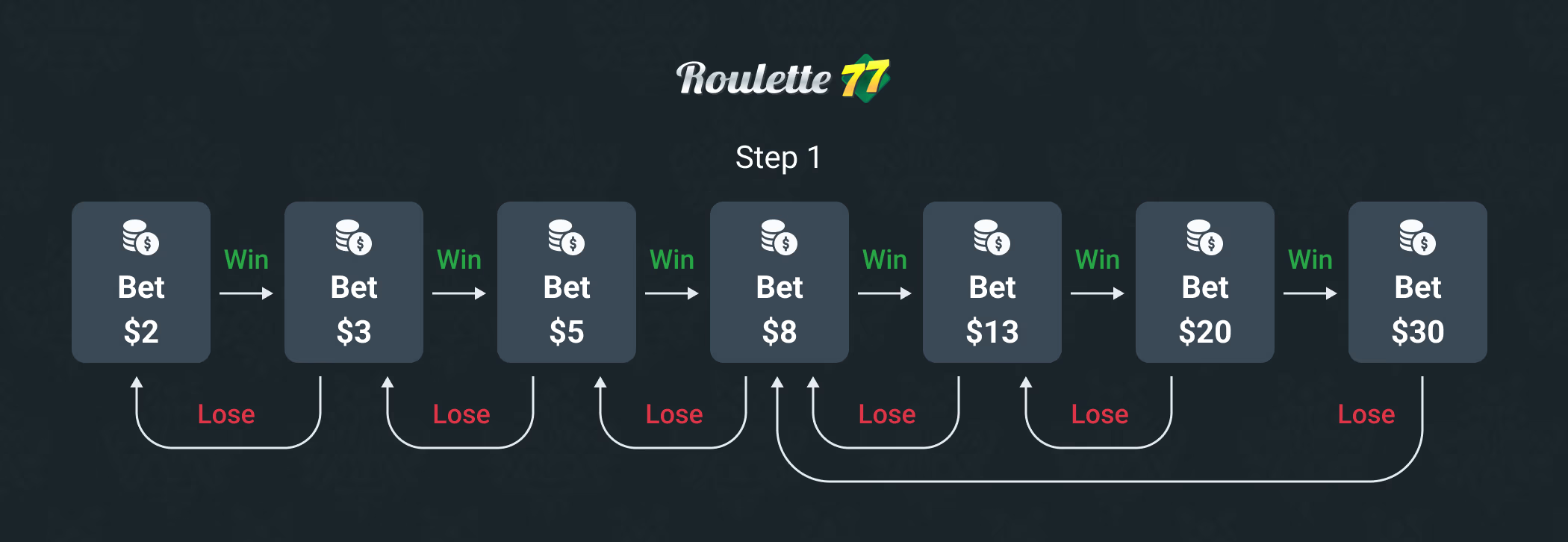
- First, you determine the number sequence you will use. The system recommends that there be at least seven and at most eleven numbers in the sequence, and that they all be odd numbers – for example, 3, 5, 7, 9, 11, 13, 15.
- However, it is not very strict on this rule, and even allows using odd and even numbers together. As a matter of fact, the following sequence is very popular among roulette players: 2, 3, 5, 8, 13, 20, 30. (We will also use this sequence in our simulation.)
- You pick a number from the middle of the sequence as your first bet amount. For example, for the 2, 3, 5, 8, 13, 20, 30 series; this number would be $8.
- You only place a bet on even money bets (red/black, odd/even, low/high).
- If you win, you use the next number to the right of the sequence as your new bet amount. (For example, if you place $8 and win, your next bet should be $13.)
- If you lose, you use the next number to the left of the sequence as your new bet amount. (For example, if you place $8 and lose, your next bet should be $5.)
- If you reach the end of the sequence from the right or left, you must end the session or start the loop from the beginning.
Let's give a practical example and show how the Askot system will work in 5 spins. In this example, we will use the 2, 3, 5, 8, 13, 20, 30 sequence and always bet on red/black.
- Spin 1
We started playing with $8 and won.
- Spin 2
Our bet is now $13. We won this spin too.
- Spin 3
Our bet is now $20. We lost this spin.
- Spin 4
Our bet is $13 again. We won this spin.
- Spin 5
We are back to $20 on this spin.
You get the general idea: Look to the right of the sequence if you win, look to the left if you lose, and use the number you see as your bet value. Since you only increase the bet after a win (and decrease it after a loss), you don't take on as much risk and can play for longer than with traditional progressive strategies.
Our Test of Askot Roulette System
We tested the Askot system with a simulation of 500 spins. In this simulation, we used three players and gave each of them a bankroll of $1000. We had them place their bets using the 2, 3, 5, 8, 13, 20, 30 sequence, as we mentioned above. In the image below, you can see what the results are. The reason why we performed the simulation using 500 spins was to see what results the system would give in both the short and long term.
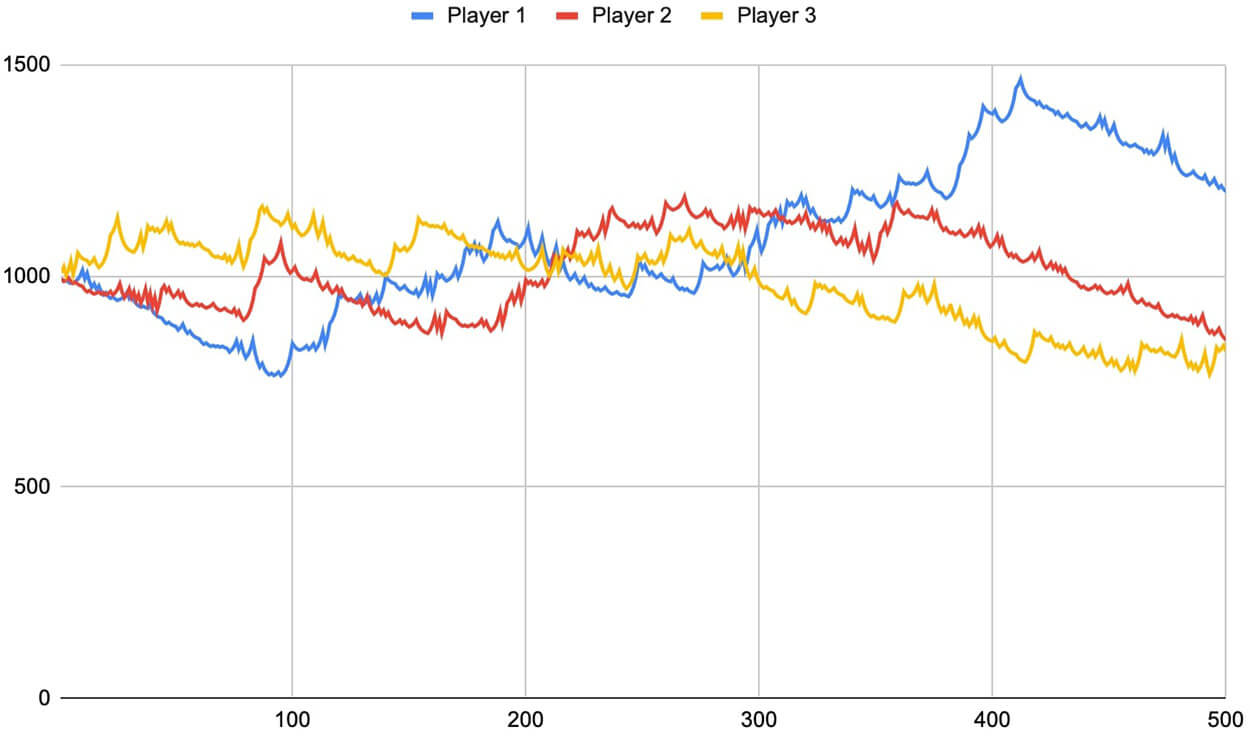
As you can see, it is not possible to say that the system gives stable results. Each of the players achieved different results. To summarize these briefly:
- Only Player 1 managed to complete the simulation with a profit ($1,200).
- Players 2 and 3 did not experience any problems in the first half of the simulation, but their losing streak towards the end caused them to suffer losses. (Player 3 was the unluckiest.)
- All players experienced multiple periods where they made profits. For example, although Player 2 completed the simulation with a loss, he made a profit between spins 87 – 103 and 212 – 433. If he had ended the game at these moments, he would not have suffered any loss. For Player 3, this period was much longer: he managed to stay with a profit between spins 200 - 400. His luck only changed towards the end of the simulation.
What to Expect from the Askot System
Let's start with the good aspects first. Unlike Fibonacci, Askot does not require a radical progression on bets that could suddenly deplete your bankroll.
However, this does not mean that it 'works'. Even if the total bet amount will not increase very quickly, losing streaks can still eat into your budget as the game time lengthens. If you're using a seven-number series, losing four times in a row will reset the system and cause you to start the whole cycle over again: are you sure you have a bankroll big enough to withstand that? Even if you use an eleven-number series, you may experience this problem.
The Askot system will also not change the RTP and house edge values of the game in the long run. So, if you don’t leave the game right after making a profit and continue playing, it becomes useless. But to be fair, this is a problem for all roulette strategies.
Finally, it is worth noting that the basis of the system is not scientific, but ‘mystical thoughts’. If the players can freely choose the sequence of numbers, why are they limited to seven or eleven numbers? What do these series mean? The Fibonacci sequence is at least based on real mathematical principles, so what is the “secret” behind Askot sequences? There is no answer to any of these questions. For the same reason, other than "gambler's fallacy" (**), there is nothing to show that they work.
(**) Gambler's Fallacy: A superstition that has no scientific basis. For example, thinking that past results will affect future results.
Conclusion
As long as you remember that it does not provide any guarantees, the Askot system can be an option for low-bankroll players in short to medium sessions, especially if you are looking for an alternative to Fibonacci. But you should not forget the golden rule: you must stop playing when you earn more money (make a profit) than when you started the game.
Until that happens, Askot can help you manage your budget efficiently and extend your playing time, but that's about it. It does not increase your chances of winning, does not provide any guarantees, and due to the random nature of roulette, it will produce different results for each player. However, since it is a low-risk strategy, it will not cause you to go bankrupt unless your luck is particularly bad. If you believe in the “magic power” of number sequences, you can try Askot instead of Fibonacci: at least you take on a much lower risk.


