








How the 7 Corners System Works
How the system works can actually be guessed from the name. You place a total of 7 corner bets and repeat this every round. You don't need to change the bet amounts or the corners either. For example, you can use the following corners:
- 1st bet: 0, 1, 2, 3
- 2nd bet: 4, 5, 7, 8
- 3rd bet: 11, 12, 14, 15
- 4th bet: 16, 17, 19, 20
- 5th bet: 23, 24, 26, 27
- 6th bet: 28, 29, 31, 32
- 7th bet: 32, 33, 35, 36
In the image below, you can see the distribution of these bets on the table. You have to place a minimum of 1 units for each bet, so you risk a total of 7 units each round. If you win, the payout is 1:8, which means 8 units (+2 or +11 units net profit). Each corner bet contains 4 numbers, so you cover 28 numbers in total. This gives you a 75.67% chance of winning in single zero roulette variants.

7 Corners System Simulation
We created a simulation to see how the 7 Corners system would work. The simulation is based on 4 players, each starting with a bankroll of 1,000 units and completing 500 spins. They place their bets according to the example above. In the image below, you can see the results that each player achieved.
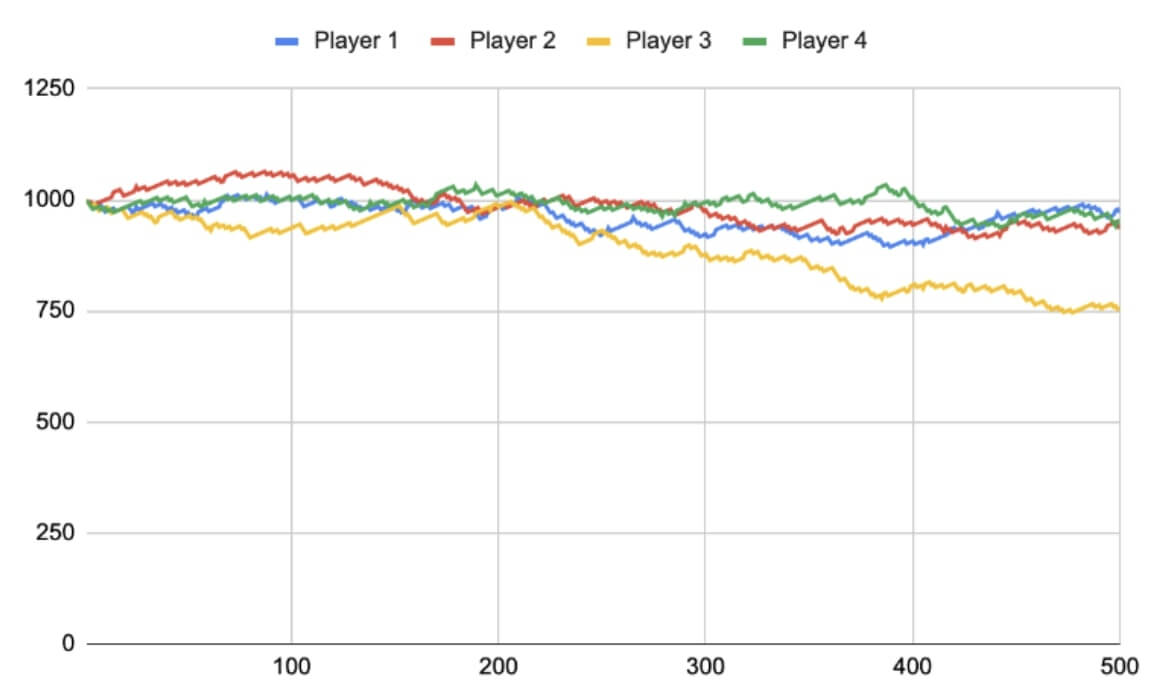
Unfortunately, no player was able to complete the simulation with a profit. Let's take a closer look at what happened to the players:
- Player 1: He made a small amount of profit on spin 69, caught a win streak, and increased his bankroll to 1,012 units on spin 89 (12 units profit). However, he was not so lucky after that. By the end of 500 spins, he had 972 units left (28 units lost).
- Player 2: He got off to a very fast start and was the luckiest player for the first 150 spins. On spin 88, he managed to make 64 units profit. However, the rest of the simulation was not so lucky. After 500 spins, he had 936 units left (64 units lost).
- Player 3: Our most unlucky player. He didn't make any profits throughout the simulation and finished 500 spins with 756 units, meaning he lost 244 units in total.
- Player 4: Things were going well for this player until spin 400, but his luck took a sudden turn after that. At the end of the simulation, his bankroll was 954 units (46 units lost).
Overall, even the most successful player didn't make a significant profit: none of them were able to win more than 10% of their bankroll. In the long run, they lost money despite the high chances of winning offered by the 7 Corners system. So, what is the reason for this?
Problems with the 7 Corners System
The same problems that apply to the Shaun system also apply here. The 7 Corners system, although not as much as Shaun, still requires you to bet a minimum of 14 units (per round) and offers a maximum of 2 units profit in return. And we know exactly how much that chance is: 75.67% in single zero roulette variants.
Imagine someone telling you “If you give me $14, there is a 75% chance that I can give you $16 back": would you accept such an offer? Was it worth the risk for only 2 units profit? How successful could you be in the long run?
This is the problem with the 7 Corners system. If the amount of profit was higher the risk could be taken, but in its current state, it is not worth your time and money. The Shaun system had the same problem, but it had a higher initial stake, so the risk of going bankrupt was higher. In the 7 Corners system, it takes longer to go bust because the starting value is lower, but the result is the same.
Conclusion
7 Corners is a system that has no real solution for loss recovery, in addition to all the problems explained above. Even losing just once will require you to play for a very long time to recover your losses. Moreover, you have to win them all: losing just one time again will start a spiral that will lead to bankruptcy. The simulation results confirm our findings. You can use it for very short game sessions, just like the Shaun system, but you should pick another strategy for medium to long game sessions.


