








How Does the 2 Up 2 Down Strategy Work?
First of all, it is important to note that this strategy is designed for outside bets. To maximise your chances of winning, it is better to choose even money bets. The strategy wants you to start with the lowest possible bet amount - let's say it is $1. After placing your first bet, you should do the following:
- Keep playing without changing the stake until you lose two times in a row.
- When you lose twice in a row, increase your bet 1x in the next round ($2). You must do this every time you lose twice in a row, i.e. the bet increase must be in the sequence 1, 2, 3, 4, 5, etc.
- As soon as you win twice in a row, return to the initial bet amount ($1) and start the whole cycle again.
Now, take a look at the picture below to quickly understand how the 2 Up 2 Down Strategy works. It visually simplifies the process of adjusting your bets after consecutive wins and losses.

Of course, you can also set the starting value to 10 or even 100 instead of 1 — this is up to you, depending on the size of your bankroll and your overall approach to real money roulette. By starting with a low amount, you are only minimising the risk. The strategy is based on the outcome of losing twice in a row: as long as this happens, you continue to increase your bet by 1x. This means that you don't need to make any changes to the bet amount unless you lose double in succession. For the same reason, the total wager amount increases in a very controlled manner.
2 Up 2 Down Strategy Tested
Like all other roulette strategies, we tested this one using a simulation. We used 4 players in the test and gave them a bankroll of $1,000 each. All players started with a bet of $1 and increased or decreased this amount as the strategy dictated. We completed a total of 1,000 spins and used an RNG (random number generator) to determine the results. In the graph below, you can see how our players performed in both the short and long term.
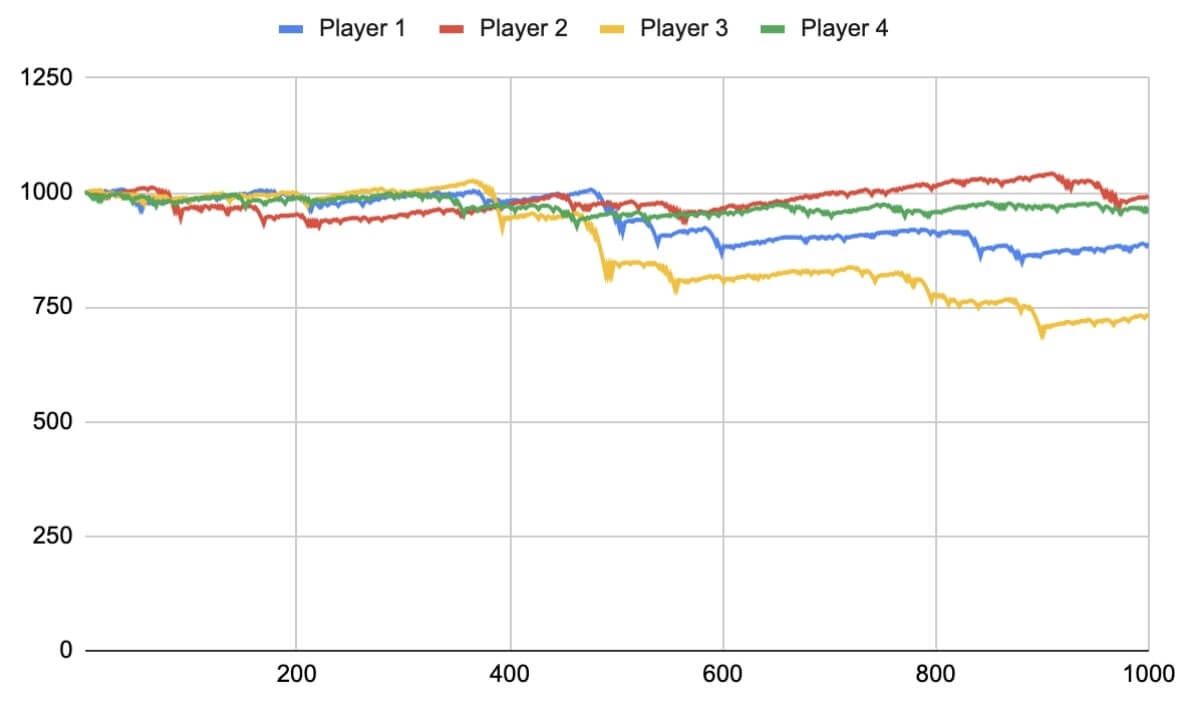
To summarise the results:
- Player 3 was the unluckiest one: he finished the simulation with $732 (loss: $268). However, if he had stopped playing on spin 365, he would have made a profit of $26.
- Player 1 was a little luckier, but not enough to complete the simulation without a loss. He too made a profit of $26 on spin 364 but failed to cover his losses after 1,000 spins. Player 4 had almost the same results.
- Player 2 was the luckiest. For a long time, it looked like he would finish the simulation with a profit (+$42 on spin 909) but after 1,000 spins, he was left with $991 (loss: $9).
Main Problems of the 2 Up 2 Down Strategy
There are basically two problems with this strategy:
It is ineffective in the short term. No player has ever made a profit before completing 360 spins. They didn't go bankrupt due to the controlled wager increase, but in real life, it will take a very long time to complete 300+ spins. If you are looking for a strategy that can be effective in short gaming sessions, this is not it.
No sustainable bankroll growth. The strategy is not effective in the long run either, except for very short winning streaks. The losses incurred by players are less than most other strategies, but that doesn't mean that they were able to make a profit. Even the most successful player lost $9 after 1,000 spins.
No flexibility. Having fixed rules means that the strategy cannot adapt to changing game conditions. For example, there is no information on where to stop if the losing streak continues - you can only keep raising and hope for the best.
Conclusion
2 Up 2 Down is a simple strategy and involves minimal risk: these are its biggest advantages. It is suitable for any level of experience and can be adapted to different bankroll sizes. It can help your betting management and make you play more disciplined. However, it is neither truly effective in the short or long term: if you are going to use it, remember this. Also, as we mentioned above, it will be better to use the strategy on even money bets and set the initial bet amount according to the lowest table limit, even if you have a large bankroll.


